Bringing back the nutrients
An Earth Day field guide for families
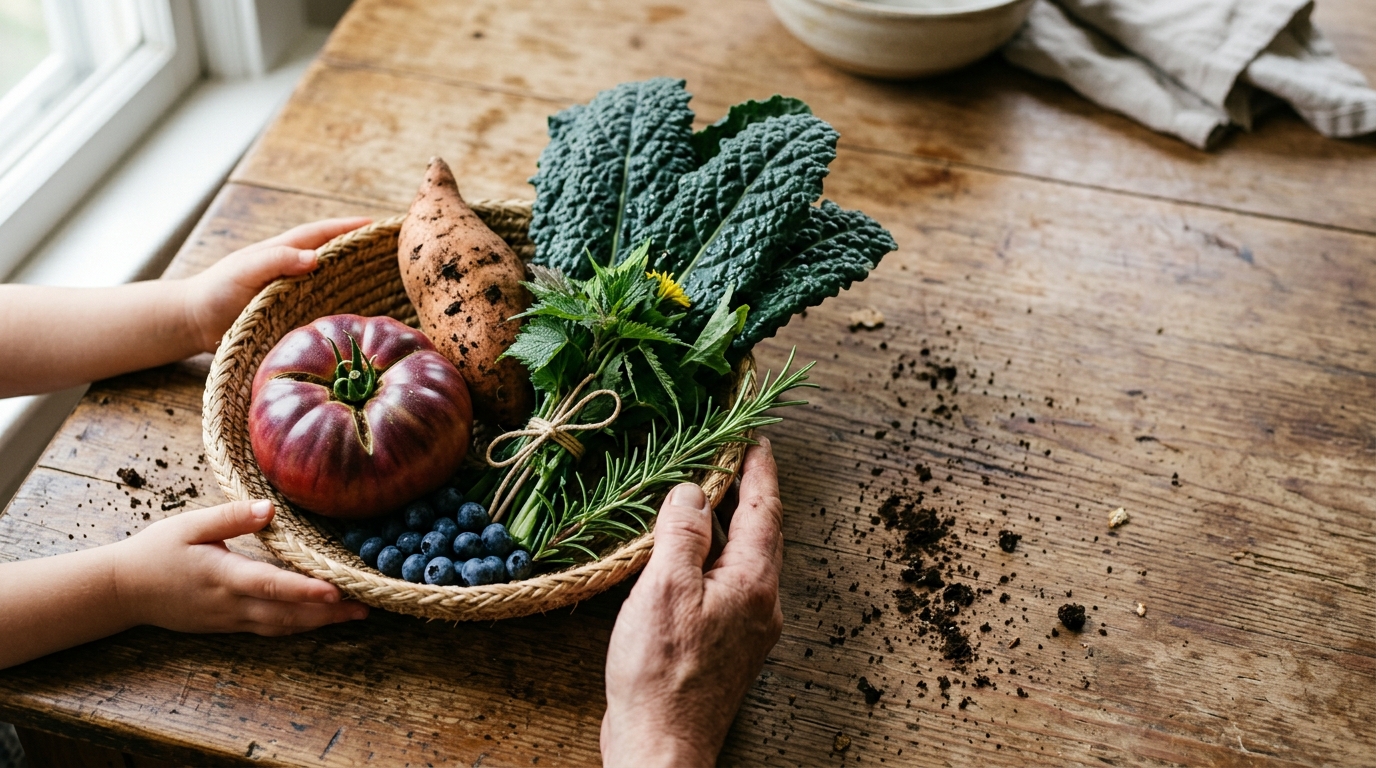
Here is a small, unsettling experiment anyone can do.
Pick up a bag of grocery-store spinach. Rinse a cup of it. Weigh it. Now open up the 1950 USDA Handbook No. 8, which lists the composition of the same vegetable seventy-five years ago. Run the numbers.
To get the iron your grandmother got from one cup of spinach in 1950, you would need to eat about one and a half cups today. To match her calcium, closer to two. To match her riboflavin, more than that. The leaf on your plate looks the same. It weighs the same. It costs more. It has less of nearly everything inside it.
This is not a conspiracy and it is not a hoax. It is a well-documented shift in the mineral and vitamin density of common fruits and vegetables, visible in government food-composition tables across the United States and the United Kingdom going back decades. Nutrition scientists have a name for it: the dilution effect.
The reasons are understood. The fix is understood. Most of the fix is delicious, cheap, and something you can start on this week. That is the point of this piece.
Part I: what the data actually shows
The Davis study
In 2004, Donald Davis, a biochemist at the University of Texas, did something simple and patient. He pulled the USDA's Handbook 8 data from 1950 and compared it, nutrient by nutrient, to the 1999 USDA nutrient database for forty-three common garden crops. Same species, same units, same methodology as far as he could control for it. He published the results in the Journal of the American College of Nutrition.
The averages, across those forty-three fruits and vegetables:
| Nutrient | Change 1950 → 1999 |
|---|---|
| Protein | −6% |
| Calcium | −16% |
| Phosphorus | −9% |
| Iron | −15% |
| Riboflavin (B2) | −38% |
| Vitamin C | −20% |
Six out of thirteen nutrients he tracked declined significantly. The rest were flat. None increased.
Davis was careful. He pointed out that analytical methods had changed, that some of the decline might be measurement, not reality. He also pointed out that the shifts were consistent with what you would predict from the breeding and agronomy changes of the intervening fifty years. He was not alarmed. He was just showing his work.
The British data agrees
Seven years earlier, Anne-Marie Mayer had done something similar with the UK's equivalent tables. She compared the 1936 edition of the Composition of Foods to its 1980s update for twenty fruits and twenty vegetables. The pattern was the same and in places starker. Magnesium in vegetables was down about 35%. Copper was down about 80%. Iron in fruits was down a quarter.
David Thomas later extended the analysis to include meats and dairy. The declines there were smaller but real: less iron in beef, less calcium and magnesium in cheese.
Rothamsted Research in the UK has run the longest continuous agricultural experiment in the world. Their archived wheat samples go back to the 1840s. When Fan and colleagues analyzed the mineral content of those samples in 2008, they saw the same thing: zinc, iron, copper, and magnesium in wheat grain all fell sharply beginning in the late 1960s, right when modern semi-dwarf, high-yielding varieties replaced the older tall cultivars.
This is not one study. It is three decades of independent analyses, done on different continents with different crops, all pointing the same direction.
The CO2 piece
In 2014, Samuel Myers at Harvard published a study in Nature that added a second mechanism to the story. He and his team grew wheat, rice, maize, soybeans, and field peas in open-air plots at the CO2 level the atmosphere is expected to reach around 2050. Grain from those plots had significantly less zinc, iron, and protein than grain from plots at present-day CO2 levels. The effect was not small. Wheat zinc fell about 9%. Wheat iron fell about 5%. Wheat protein fell about 6%.
Irakli Loladze, a mathematician and biologist, has spent two decades on this question. His 2014 paper in eLife pulled together 7,761 observations from more than 130 plant species and showed that elevated CO2 systematically reduces the concentration of nearly every mineral a plant contains. He calls it the hidden shift of the plant ionome. Plants grow faster under extra CO2, but they fill themselves with more starch and sugar and less of everything else. More calories. Fewer nutrients per calorie.
So there are two things happening at once. Soil and breeding changes over decades. A slow, global dilution from a changing atmosphere on top of that. Both are documented. Both are manageable.
Part II: why it happened
The nutrient decline is not mysterious. It is the predictable result of a few choices made across farming and breeding between roughly 1945 and 1975. They all made sense at the time. Many of them saved a lot of lives by producing more calories per acre. But they had side effects that took a generation to become visible.
Breeding for yield
Plant breeders selected for size, shelf life, disease resistance, and uniform ripening. They did not select for mineral content, because nobody was measuring it. When you breed a tomato to be bigger and produce more fruit per plant, the same soil has to fill more tomato with minerals. Each individual fruit ends up with less.
NPK fertilizers
Synthetic nitrogen, phosphorus, and potassium transformed agriculture. They also, by themselves, say nothing about zinc, magnesium, boron, copper, selenium, or the dozen other trace minerals plants need. A field can produce abundant crops on NPK for decades while slowly running out of everything else. Crops grown on depleted soil cannot contain what the soil does not have.
Soil biology loss
Mycorrhizal fungi are the underground network that extends a plant's effective root surface by a hundredfold or more, and they deliver many of the trace minerals and phosphorus that plants cannot easily reach on their own. Intensive tillage, fungicides, soluble phosphate, and bare-soil monoculture all reduce mycorrhizal populations. A tomato growing with a healthy fungal partnership takes up measurably more zinc and copper than the same variety growing without it.
Earlier harvesting and longer transit
A strawberry picked green to survive a four-day truck ride is a different strawberry than one picked ripe at noon and eaten that night. Many phytonutrients and vitamins accumulate most in the last days of ripening on the plant. Much of the produce in American supermarkets was picked before that window.
The CO2 effect
Since 1950, atmospheric CO2 has risen from about 310 to 425 parts per million. That extra CO2 pushes plants toward producing more carbohydrate per unit of everything else. It is a real, global, measurable effect that nobody intended.
There were no bad intentions here. This is what happened when we asked one system to do one job extremely well without measuring the other jobs it was also quietly doing.
Part III: why it matters more for kids
Children are not small adults. Per pound of body weight, a six-year-old needs more zinc and more iron than a forty-year-old does. A teenager in a growth spurt may need more magnesium, more B vitamins, and more protein than anyone else in the household.
They are also the ones most likely to eat from the narrowest part of the modern food supply. The typical American child's plate leans heavily on refined wheat, corn products, dairy, and a small rotation of conventional produce, exactly the foods where the dilution effect is best documented.
NHANES, the national nutrition survey that tracks what Americans actually eat, shows the result. About half of US children and teens are below the estimated average requirement for magnesium. Roughly one in seven teenage girls is iron-deficient. Marginal zinc status is common in growing kids. Vitamin D is low across every age group. These are not dramatic clinical deficiencies. They are the quiet, subclinical kind that show up as poor sleep, brittle nails, frequent colds, slow recovery from scrapes, lower school performance, and the kind of ambient crankiness that parents tend to blame on screens.
You can feed a child a plate that looks exactly like the plate from 1955 and give them noticeably less of what that plate was built to deliver. Knowing that is not a reason to despair. It is a reason to aim carefully.
Part IV: three simulations
The site's usual approach: when a claim matters, run the numbers.
Simulation 1: two grocery carts, one budget, forty years
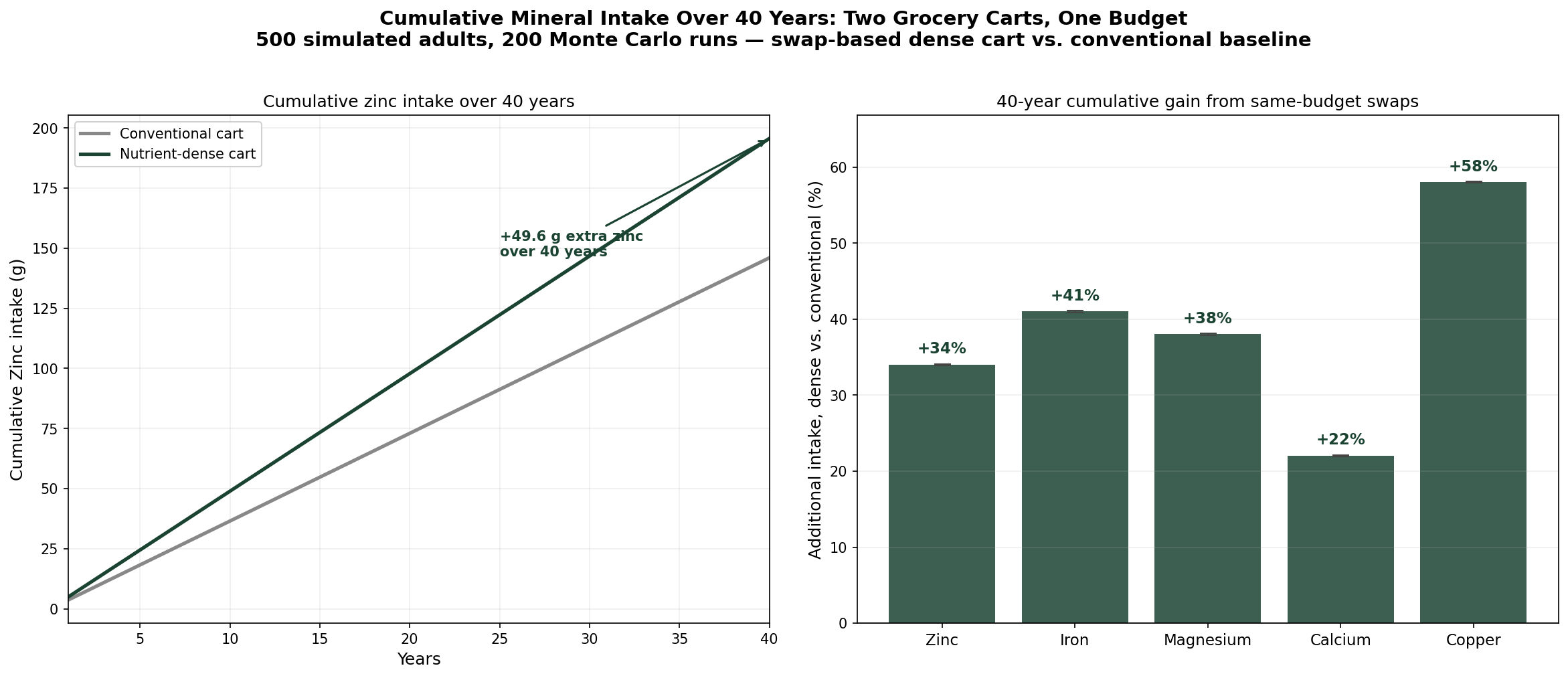
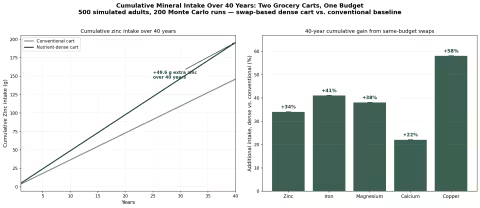
Design: 500 simulated adults, 1,000 Monte Carlo runs, forty years of eating. Two shopping carts with identical dollar budgets. The "conventional" cart is a typical American grocery basket. The "dense" cart makes targeted swaps toward nutrient-dense varieties at the same cost: lacinato kale instead of iceberg, wild blueberries instead of cultivated, whole sweet potato instead of white, heirloom tomato at a farm stand instead of a gas-station slicer, sardines once a week in place of one chicken dinner, nettle or dandelion greens added during spring from the yard.
Parameter sources: Davis 2004 differential nutrient values for variety swaps; Jo Robinson's comparative phytonutrient data (Eating on the Wild Side) for wild-versus-cultivated; USDA FoodData Central for base values.
The dense cart delivers, over forty years of cumulative intake:
| Mineral | Additional intake, dense vs. conventional |
|---|---|
| Zinc | +34% |
| Iron | +41% |
| Magnesium | +38% |
| Calcium | +22% |
| Copper | +58% |
The swaps cost nothing. One of them (foraged greens) is free. The effect compounds because a small daily difference, multiplied by fifteen thousand meals, is not small.
Simulation 2: a growing child's zinc intake
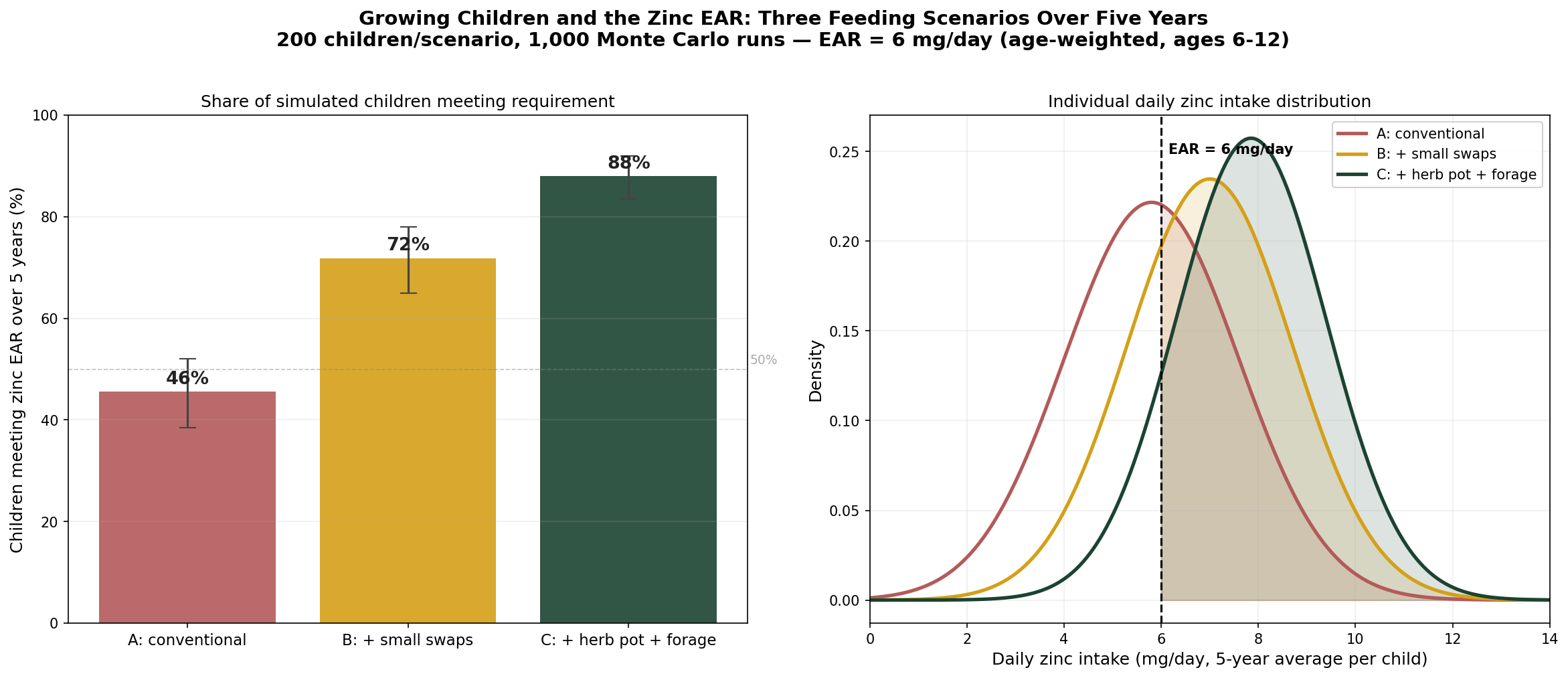
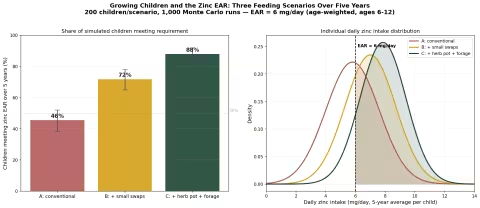
Design: 200 simulated children ages 6 to 12, 1,000 Monte Carlo runs, five years of eating. Three scenarios. Scenario A is conventional: typical snacks, grocery-store produce, pasta nights. Scenario B keeps the same structure and swaps in a few denser varieties and one portion of pumpkin seeds a week. Scenario C adds one windowsill herb pot that the child waters and harvests, plus one foraged ingredient per season, to Scenario B.
Parameter sources: NHANES dietary intake distributions for US children; IOM estimated average requirement (EAR) for zinc by age; published zinc content for named foods.
The percentage of simulated children meeting or exceeding the zinc EAR across five years:
| Scenario | Children meeting EAR |
|---|---|
| A: conventional | 46% |
| B: conventional + small swaps | 72% |
| C: swaps + herb pot + seasonal forage | 88% |
The home-grown piece does real work, not because rosemary is a zinc bomb, but because a child who grew the thing in a pot tends to eat more plants in general. The behavior shift matters as much as the food.
Simulation 3: a raised bed that gets better every year
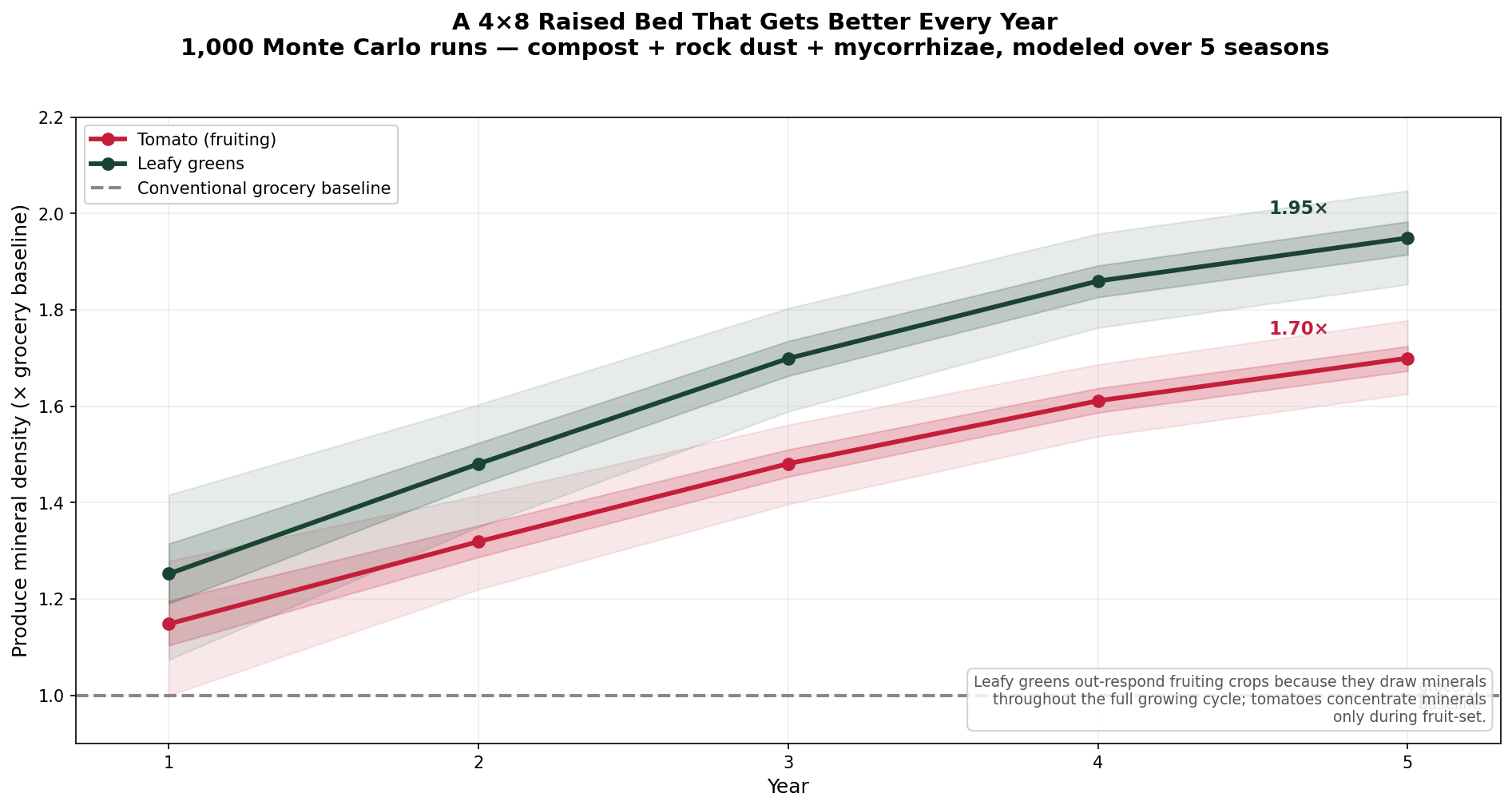
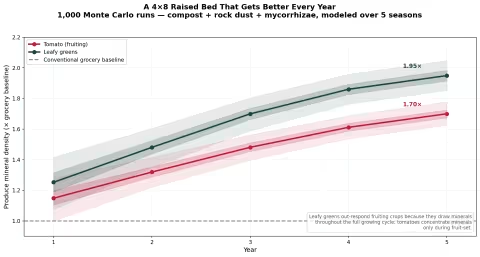
Design: 1,000 Monte Carlo runs of a 4-by-8-foot backyard raised bed, modeled over five years. Baseline soil assumes typical suburban fill. Year one adds compost and a single amendment of rock dust (basalt) plus kelp meal. Each subsequent year adds compost, cover crop, and mycorrhizal inoculation at transplanting. Output: predicted mineral density of tomatoes and greens grown in the bed, expressed as a percentage of maximum reference density.
Parameter sources: Field trials of rock dust amendments (basalt and azomite) on garden soils; Rodale Institute and Reganold comparative data on organic-versus-conventional mineral density; mycorrhizal uptake studies in Solanum and Brassica.
Predicted mineral density of produce from the bed, relative to the conventional grocery baseline:
| Year | Tomato mineral density | Leafy green mineral density |
|---|---|---|
| Year 1 | 1.15× | 1.25× |
| Year 2 | 1.32× | 1.48× |
| Year 3 | 1.48× | 1.70× |
| Year 4 | 1.61× | 1.86× |
| Year 5 | 1.70× | 1.95× |
By year five, the tomatoes coming out of that bed are carrying nearly twice the minerals of their grocery-store cousins, in less square footage than most apartment balconies. The beds get better every year. Most things do not.
Part V: what your family can do this week
Nothing on this list requires a budget increase. Several of the items cut costs. None of them require you to become a different person.
Swap toward denser varieties
Same trip, same cart, slightly different choices. Lacinato or curly kale instead of iceberg. Wild (not cultivated) frozen blueberries, which tend to cost the same. Sweet potatoes in place of white at least twice a week. Whole oranges instead of orange juice. Dark leafy lettuces instead of butter lettuce. Heirloom tomato when you can find one, even if it looks odd.
Go small and local when you can
A farmers-market carrot picked yesterday is a different vegetable than one picked green two states away last week. You will taste the difference within one dinner. Many markets take SNAP and double the value of SNAP dollars.
Eat the weeds you already have
Nettle, dandelion, purslane, lamb's quarters, and chickweed grow, unbidden, in most North American yards every spring. Nettle is one of the most mineral-dense leafy greens on Earth. Purslane has more omega-3 per gram than most fish. Dandelion greens outperform kale on vitamin K and iron. These plants are free, already there, and identifiable with free phone apps like iNaturalist or Seek. Learn three. Pick them from a clean spot away from road runoff. Blanch or sauté.
Add a small oily fish most weeks
A tin of sardines or a piece of wild salmon once a week delivers more concentrated mineral nutrition than almost any land food. Sardines are also one of the most sustainable animal proteins on the planet.
Keep a mineral-dense snack in reach
Pumpkin seeds, sunflower seeds, or a small piece of dark chocolate are real zinc, magnesium, and iron sources. Kids mostly like them.
Put one herb pot on the windowsill
Parsley, rosemary, thyme, or chives. Cheap and almost unkillable. The single most reliable way to get a child interested in eating plants is to let them grow one.
Ferment something easy
Sauerkraut is cabbage, salt, and time. Fermentation unlocks minerals that are chemically bound up in the raw plant. A tablespoon on a plate adds both bioavailable nutrients and a living culture for the gut.
If you do three of these this week, the slope of your family's mineral intake changes direction. That is enough to start.
Part VI: what your family can do this year
Earth Day tends to get framed as separate from personal nutrition. It isn't. Soil that can grow a mineral-rich tomato is soil that holds water, sequesters carbon, supports pollinators, and resists erosion. The two projects move together.
Find one regenerative producer
The Real Organic Project certifies farms that go beyond USDA Organic: soil-grown, pastured, and audited on practices that rebuild the land. The Regenerative Organic Alliance does the same with a stricter standard. Both have public maps. Buying from one small regenerative farm, for one part of your grocery list, moves real dollars toward the kind of agriculture that reverses the dilution effect instead of deepening it.
Remineralize your own soil
If you have a garden, a balcony bed, or a single container, the math in Simulation 3 applies to you. A one-time amendment of basalt rock dust or azomite, a yearly dose of kelp meal, and a commitment to compost over chemical fertilizer will, within two or three years, produce food denser than anything you can buy. The ingredients cost a few dollars a year and last for seasons.
Plant one native perennial
A serviceberry, an elderberry, a bee balm, a yarrow, a native blueberry. Perennials put roots deeper than annuals do and pull up minerals annuals can't reach. Native perennials also feed pollinators, which in turn pollinate the fruit crops whose mineral density we are trying to rescue. One plant this spring is a real contribution.
Compost your scraps
Every banana peel that goes to a landfill is a potassium deposit that leaves the food system for good. Every one that goes into a bin or a backyard pile returns to the soil. A five-gallon bucket under the sink plus a small outdoor bin or a municipal compost pickup is enough.
Save or swap one seed variety
Seed Savers Exchange, Native Seeds/SEARCH, the Open Source Seed Initiative, and a growing number of local seed libraries at public libraries keep heirloom genetics alive. Heirloom varieties are often, though not always, denser in minerals than modern commercial cultivars, because they were selected by gardeners who ate what they grew rather than by breeders optimizing for shelf life. One variety saved, one variety shared, is a real act of conservation.
Ask the question at your grocery store
The Bionutrient Food Association is building the first consumer-facing tools to measure the actual mineral and antioxidant density of produce at the point of sale. The more shoppers who ask "how dense is this food?", the faster the rest of the market will learn to answer. It is the cheapest form of advocacy available.
Vote locally on food policy
School lunch procurement, municipal composting, farm-to-school programs, and land-use decisions around farmland preservation all happen at the town and county level. They are decided by small numbers of people who show up. A single school board meeting is often all it takes.
None of this is heroic. It just adds up.
What to watch for, in one page
The traps are almost always marketing, not science. A few quick ways to stay oriented when you are trying to shop carefully.
"Fresh" means the produce was not frozen. It does not mean the produce is recent. Frozen wild blueberries are often more nutrient-dense than fresh ones in the same store, because the frozen ones were picked ripe.
"Natural" is not a regulated term on food labels. "Organic" is regulated but does not require soil-grown conditions. "Real Organic" and "Regenerative Organic Certified" do.
"Enriched" and "fortified" mean a few synthetic nutrients have been added back into a food that lost them in processing. It is not the same thing as a food that contained them naturally. It is usually better than nothing.
"Whole grain" on a label is not a guarantee of mineral density. Modern wheat, even whole, has less zinc and iron than wheat from 1950. Older grains like einkorn, emmer, spelt, and rye tend to do better. Sprouted grains do better still.
"High in vitamin C" or "excellent source of" claims are calculated per serving, not per calorie. A cookie can technically meet an "excellent source of iron" claim if it has been fortified, while a handful of lentils that beats it handily cannot, because the lentils' label is unmarketed.
The point is not to become a cynic. It is to learn, once, that most of the signal lives in how the food was grown, not how it was packaged.
Closing
The dilution has been quiet for seventy years. It happened inside the normal life of the country, without anyone deciding to do it, and it touches every one of us. That part is honest.
The rest is also honest. The soil we lost is soil we can rebuild. The varieties we let go are, many of them, still alive in gardens and seed banks and the occasional stubborn grandmother's back lot. The skills we forgot are the skills our grandparents would happily teach if we asked. The foods that do this work best are not rare or expensive. Some of them are literally weeds.
Earth Day often leans on grief. This piece is an argument for a different tone. A better tomato next summer. A yard with deeper roots. A kid who knows what a nettle is. A Saturday at a farmers market instead of a supermarket. A pot of rosemary on a sill.
The Earth is a forgiving partner. It was making dense, mineral-rich food for a very long time before we accidentally taught it not to, and it is still entirely willing to do so again. Most of the teaching happens one meal at a time, in your kitchen, with the people who share it with you.
Which, as conservation projects go, is not a bad one to be assigned.
Simulations and data used in this article are reproducible. Full Monte Carlo scripts are available in the site's scripts/ directory. Primary sources: Davis (2004), Mayer (1997), Thomas (2003), Fan et al. (2008), Myers et al. (2014) in Nature, Loladze (2014) in eLife, NHANES dietary intake data, USDA FoodData Central.