The Tilted Head and the Quiet Ear
A Natural-Rearing Guide to Middle and Inner Ear Infections in Cats
There is a particular kind of morning that every cat owner dreads. The cat who was fine yesterday is now sitting with her head canted strangely to one side, as though she is listening to something below the floor. When she stands, she lists. When she walks, she circles toward the tilt, or topples into the wall. Her eyes — if you look closely — are flicking rhythmically from side to side, a fine involuntary tremor called nystagmus. She may be drooling slightly, or holding one ear flat, or simply looking miserable and still in a way that cats almost never are.
This is what a deep ear infection looks like in a cat. Not the scratching, head-shaking, smelly-ear picture most people imagine — that is the outer ear. This is something that has traveled further in, behind the eardrum and into the chamber that houses the organ of balance itself. It is otitis media (middle ear) and otitis interna (inner ear), and it is one of the few feline ear problems that genuinely qualifies as an emergency.
This guide is written in the spirit of Juliette de Bairacli Levy — the herbalist who, more than anyone, taught the modern world that animals can be reared and healed with food, herbs, and respect for their own healing instincts. But it is written with an honesty she herself prized: she was a fierce advocate of observation, and the honest observation here is that a true middle- or inner-ear infection in a cat is not a condition to be managed by herbs alone. It is a condition where natural rearing and veterinary medicine belong side by side — the herbs and diet doing what they do best (supporting, soothing, preventing, and building the kind of animal that rarely gets sick in the first place), and the veterinarian doing what she does best (looking behind the eardrum, culturing the bug, and reaching tissue that no ear drop can touch).
Let's start with the history, because it is a surprisingly good one.
Part I: Three Thousand Years of the Aching Ear
The Oil-and-Honey Centuries
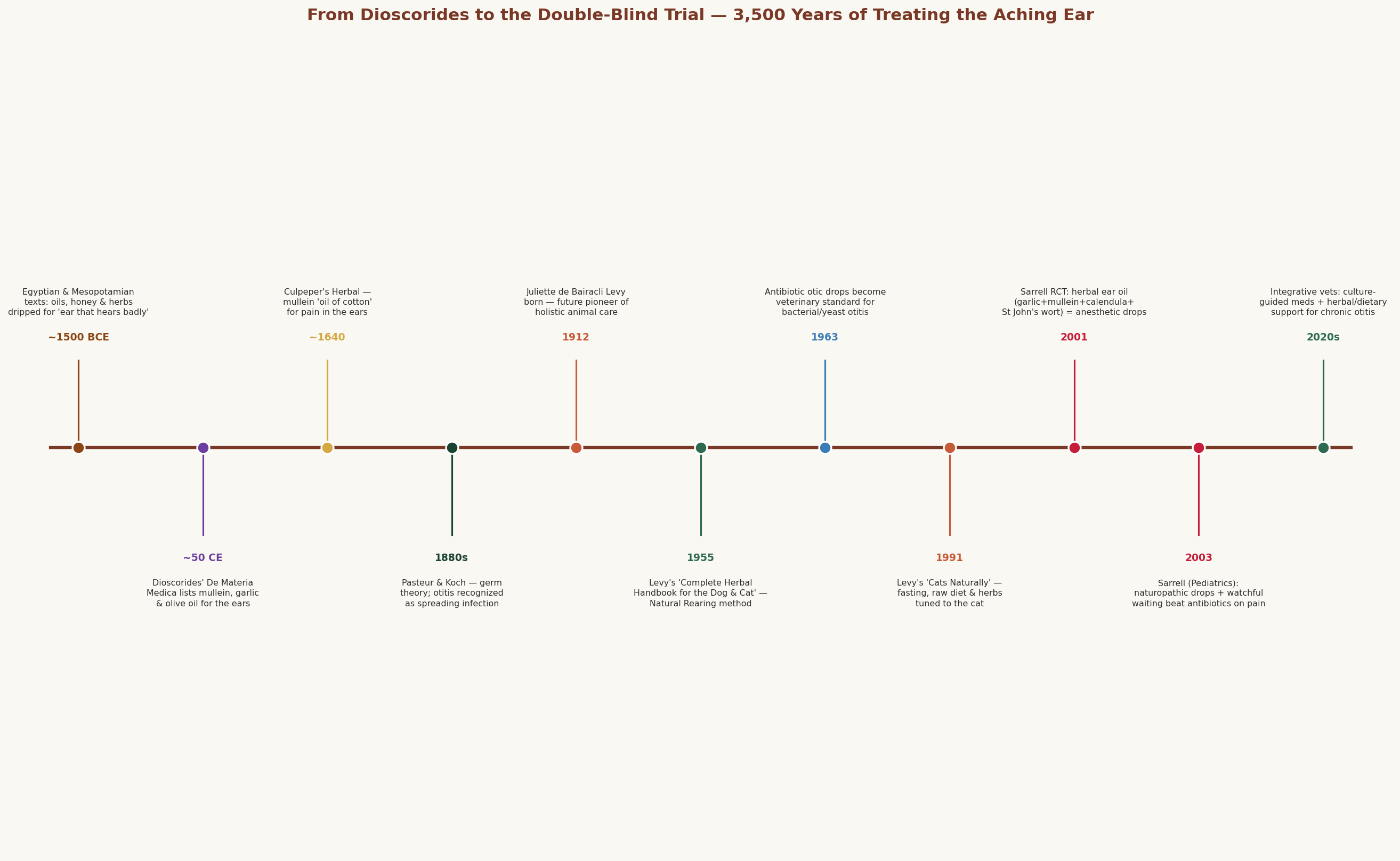
The ear is one of the oldest documented sites of folk medicine. Egyptian and Mesopotamian medical texts from around 1500 BCE describe warmed oils, honey, and herbal infusions dripped into "the ear that hears badly." The Greek physician Dioscorides, writing his De Materia Medica around 50 CE, catalogs the very plants that would still be in an herbalist's ear-drop bottle two thousand years later: mullein (Verbascum), garlic (Allium sativum), and olive oil as the carrier.
The thread runs unbroken through the centuries. The English herbalist Nicholas Culpeper, in his 1640s Complete Herbal, recommended an "oil of mullein flowers" for "pains in the ears." Marshmallow, calendula, and St. John's wort all earned their place in the traditional ear pharmacopeia. None of this was specific to humans — the same oils were dripped into the ears of working dogs, horses, and barn cats, because for most of history there was no veterinary medicine distinct from human medicine. There was just medicine, and it was mostly botanical.
Germ Theory Changes the Question
In the 1880s, Pasteur and Koch established that infections are caused by microorganisms. Suddenly the aching ear had a mechanism: bacteria and fungi, multiplying in a warm, moist, poorly drained canal, sometimes punching through the eardrum and spreading inward. By the 1960s, antibiotic and antifungal otic (ear) drops had become the veterinary standard for bacterial and yeast otitis, and they remain — appropriately — the front line for confirmed infection today.
Juliette de Bairacli Levy and the Natural-Rearing Counter-Current
Against this rising tide of pharmaceutical medicine, one woman swam deliberately upstream. Juliette de Bairacli Levy (1912–2009) was a British herbalist, Afghan-hound breeder, and traveler who learned plant medicine from the Romani people, Bedouin shepherds, and farmers across the Mediterranean. In 1955 she published The Complete Herbal Handbook for the Dog and Cat, and in 1991 the cat-specific Cats Naturally. Together they founded what we now call holistic animal care.
Her central doctrine was Natural Rearing: feed the animal a raw, species-appropriate diet; minimize the artificial (she was famously skeptical of routine vaccines and chemical pesticides); and when illness comes, support the body's own healing through fasting, herbs, honey, and sunlight rather than suppressing symptoms. She watched what sick animals chose to eat when left to themselves, and built her medicine around it.
Her approach to the ear was characteristically simple: keep it clean with mild herbal antiseptics and oils, treat parasites (ear mites) with oil-based applications, and treat the whole animal — because she believed, correctly, that chronic ear trouble is usually a sign of a deeper imbalance, not an isolated event.
The Trials That Vindicated the Oil Bottle
Here is the part of the story that herbalists love and skeptics rarely expect. In 2001, a team led by E.M. Sarrell published a double-blind randomized trial in Archives of Pediatrics & Adolescent Medicine (PMID 11434846). They took 103 children with the ear pain of acute otitis media and gave half of them an herbal ear oil — garlic, mullein, calendula, and St. John's wort in olive oil, almost exactly Dioscorides' recipe — and the other half a conventional anesthetic ear drop. The herbal oil relieved pain just as well as the pharmaceutical drop.
A follow-up trial in Pediatrics in 2003 (PMID 12728112) went further: the herbal ear oil combined with watchful waiting controlled ear pain at least as well as adding antibiotics. Two thousand years of folk practice had survived contact with the double-blind trial — at least for pain and comfort of the outer ear.
We will return to exactly what these trials do and do not prove. But they are the reason this article takes the herbal tradition seriously rather than dismissing it.
Part II: The Anatomy — Why "Ear Infection" Means Three Very Different Things
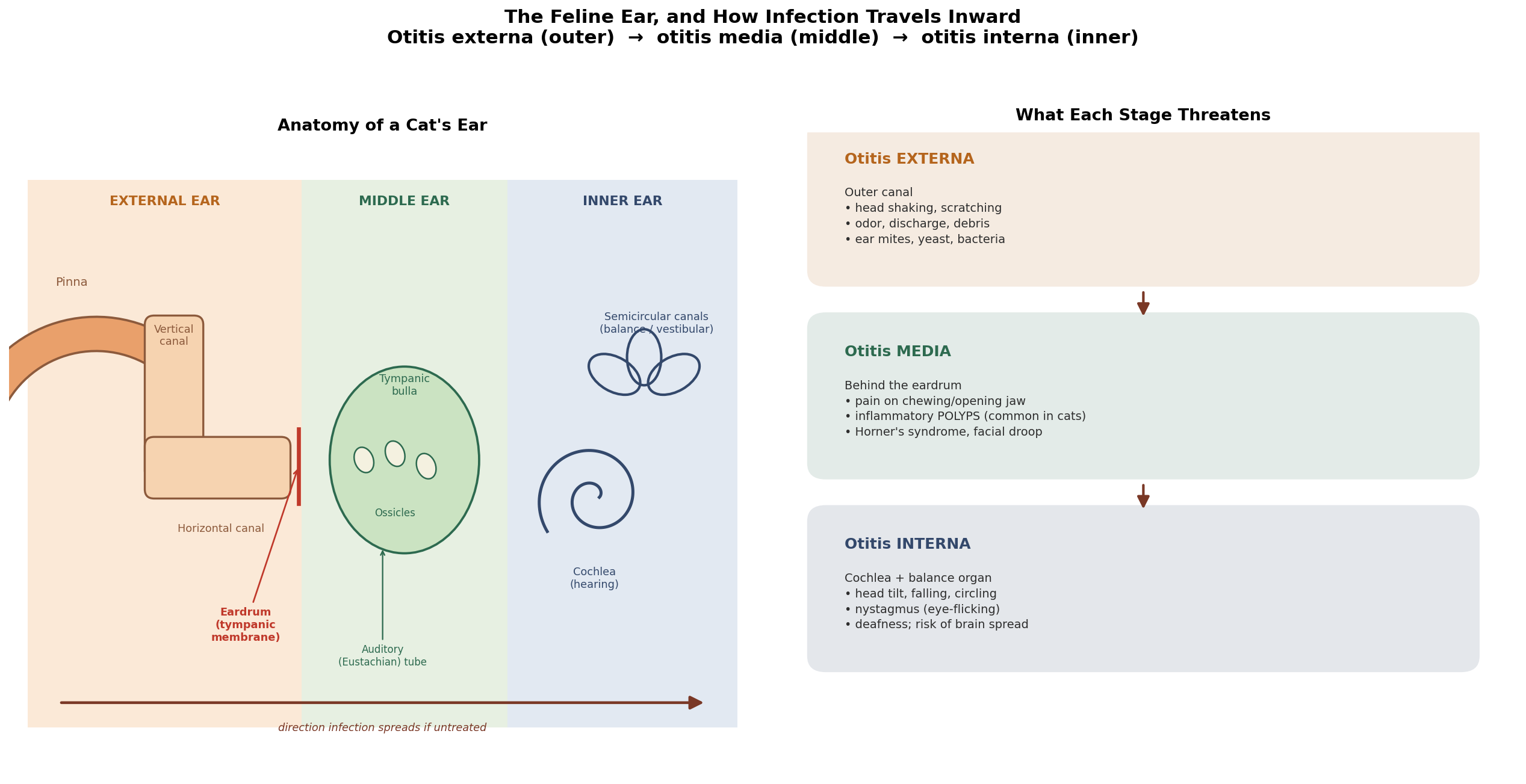
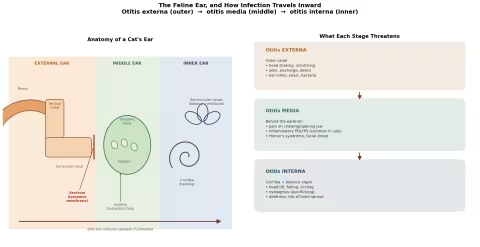
To treat a cat's ear sensibly, you have to know which of three compartments is in trouble. They are nested inside one another like rooms, and an infection that starts in the outermost can, if neglected, march into the innermost.
The External Ear (Otitis Externa)
This is everything from the pinna (the visible flap) down through the ear canal to the eardrum. The cat's ear canal is famously L-shaped — a vertical segment that turns into a horizontal one — which means debris, wax, and moisture drain poorly and infections love to set up shop. This is the ear you can actually see into, and the ear that most "natural ear care" is genuinely appropriate for.
Otitis externa announces itself loudly: head shaking, scratching at the ear, an odor, dark or waxy discharge, redness. In cats the single most common driver is the ear mite (Otodectes cynotis), which produces a characteristic dry, dark, coffee-ground debris. Yeast (Malassezia) and bacteria are also common, often moving in after mites or moisture have disturbed the canal.
The Middle Ear (Otitis Media)
Behind the eardrum lies the tympanic bulla, an air-filled bony chamber containing the tiny ossicles that conduct sound, connected to the back of the throat by the auditory (Eustachian) tube. Infection reaches here in two main ways: by extending inward through (or around) a damaged eardrum from a neglected outer-ear infection, or by traveling up the Eustachian tube from the throat.
In cats, there is a third route that deserves special emphasis: the inflammatory polyp. These are benign fleshy growths that arise from the lining of the middle ear or the Eustachian tube, and they are disproportionately common in cats, especially young ones. A polyp can both cause middle-ear disease and block normal drainage, setting up a chronic, stubborn infection that no ear drop will ever fully clear because the plumbing itself is the problem.
Signs of otitis media are subtler than the outer ear: pain when opening the jaw or chewing, a reluctance to be touched around the head, and — tellingly — neurological signs from the delicate nerves that pass through this chamber. A drooping lip or eyelid, an inability to blink (facial nerve paralysis), or a constricted pupil with a droopy lid on one side (Horner's syndrome) all point to middle-ear involvement.
The Inner Ear (Otitis Interna)
The innermost chamber is the most precious. It houses the cochlea, the spiral organ of hearing, and the vestibular apparatus — the three semicircular canals and associated organs that tell the brain which way is up. When infection reaches here, the consequences are dramatic and unmistakable:
- Head tilt toward the affected side
- Loss of balance — stumbling, falling, circling, rolling
- Nystagmus — involuntary rhythmic flicking of the eyes
- Nausea, drooling, reluctance to move
- Deafness on the affected side
This is peripheral vestibular disease, and while it looks like a stroke to a frightened owner, in a cat it is most often an inner-ear infection — and that is, relatively speaking, good news, because it is treatable. The danger is that the inner ear sits directly against the brainstem; an uncontrolled inner-ear infection can, rarely, spread inward to cause meningitis or a brain abscess. This is the line that natural-care-alone must never cross.
Part III: What Actually Causes It — The Feline Picture Is Different
If you read general "ear infection" advice written for dogs and apply it to cats, you will be wrong more often than you are right. Dogs are dominated by allergic, yeast-driven ear disease — floppy-eared breeds with food or environmental allergies that inflame the canal and let Malassezia bloom. Cats are a different animal entirely.
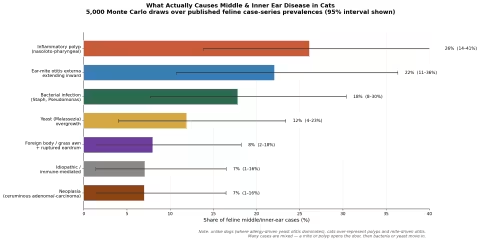
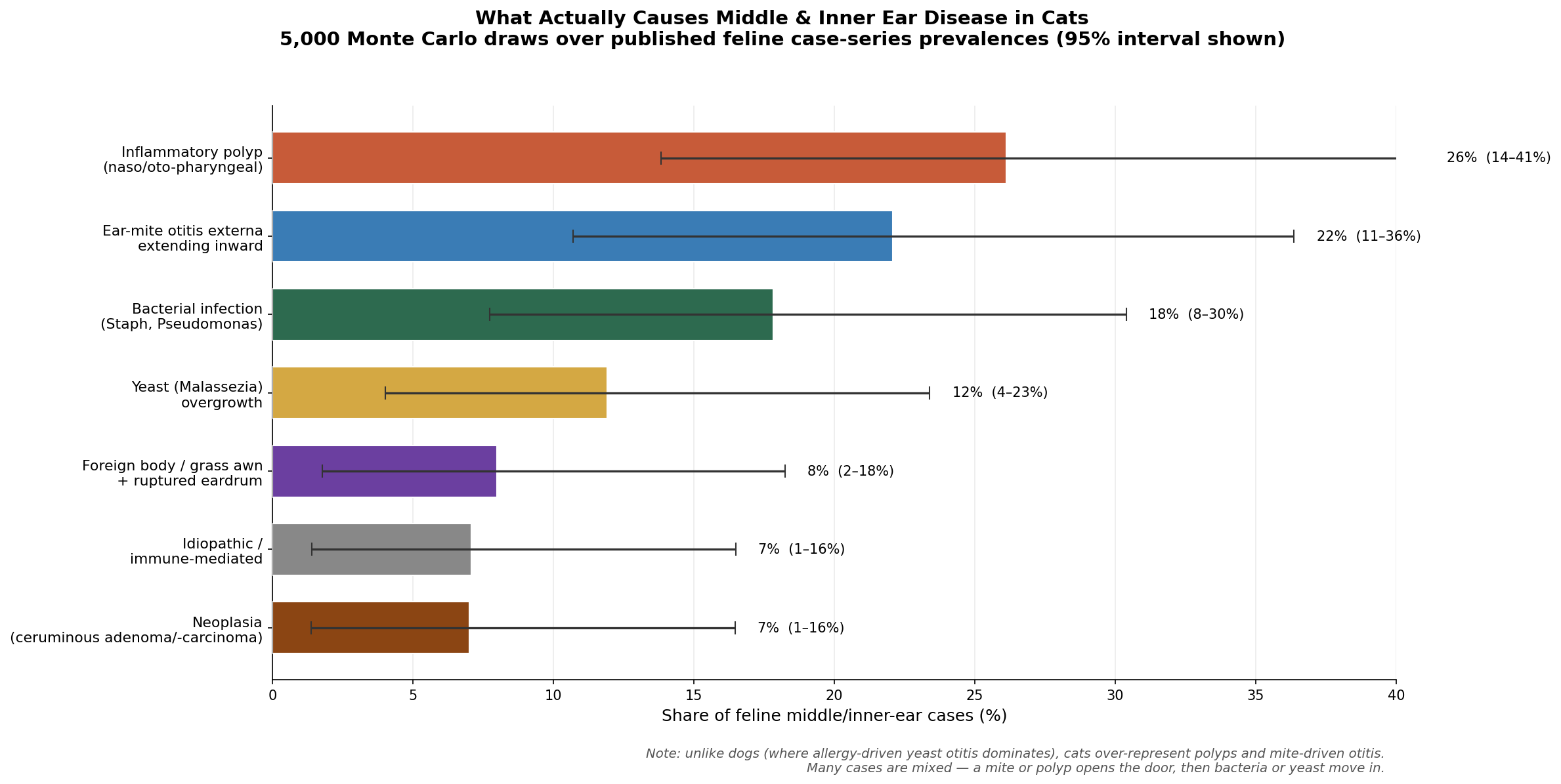
The figure above is a Monte Carlo synthesis of feline ear-disease case series — 5,000 simulated draws over the published prevalence ranges, with the 95% interval shown to be honest about how much these numbers vary from clinic to clinic. The feline pattern that emerges:
- Inflammatory polyps (~26%) — the signature feline cause of middle-ear disease, especially in cats under three years old. These need to be physically removed, not medicated away.
- Ear-mite otitis externa extending inward (~22%) — mites are far more important in cats than dogs, and a heavy, neglected mite infestation can rupture the eardrum and seed the middle ear.
- Bacterial infection (~18%) — Staphylococcus, Pseudomonas, and others, usually as secondary invaders.
- Yeast / Malassezia (~12%) — common but less dominant than in dogs.
- Foreign bodies and grass awns (~8%) — an outdoor cat can drive a grass seed straight through the eardrum.
- Neoplasia (~7%) — tumors of the ear-canal glands (ceruminous adenoma/adenocarcinoma); more of a concern in older cats.
- Idiopathic / immune-mediated (~7%) — the unexplained remainder.
The single most important clinical fact buried in that list: most real feline middle/inner-ear disease is either mechanical (a polyp, a foreign body, a tumor) or a deep secondary infection. Both categories require a veterinarian to look and often to do something physical. This is precisely why the natural-rearing approach for these deep infections is supportive and preventive rather than curative.
The two-question triage that should guide everything that follows:
-
Is this the outer ear, or deeper? Head shaking and scratching with a clean neurological exam → likely outer ear, where gentle natural care is reasonable. Head tilt, stumbling, flicking eyes, facial droop, or pain on chewing → deeper, and that means a vet, today.
-
Could the eardrum be ruptured? If a cat shows any inner- or middle-ear sign, you must assume the eardrum may be perforated — and that means nothing goes into that ear canal until a veterinarian has examined it. Many ear preparations, including some herbal and essential-oil products, are toxic to the inner ear (ototoxic) if they reach it through a ruptured drum.
Part IV: The Yeast Ear — Malassezia in Close-Up
Of all the things that can go wrong inside a cat's ear, yeast is the one most owners actually encounter — and the one most surrounded by half-truths. So it deserves a section of its own.
What the yeast actually is
The organism is Malassezia pachydermatis, a budding, lipid-loving yeast that lives in tiny, harmless numbers on the normal skin and ear canals of healthy cats. It is a commensal — a quiet resident — until something tips the canal's ecology in its favor. When that happens, the population explodes from a handful of cells into a teeming bloom, and the bloom is what produces symptoms.
Under the microscope the cells are unmistakable: small, oval, and pinched in the middle so they look like peanuts, snowmen, or tiny footprints — the "broad-based budding" shape that lets a veterinarian confirm yeast in about thirty seconds with a cotton swab, a glass slide, and a drop of stain. This is the single most important fact about yeast ears: the diagnosis is made by looking, not by guessing. Brown waxy gunk in a cat's ear could be yeast, could be a bacterial infection, could be mite debris, could be plain wax — and they are treated differently. Cytology is what tells them apart, and it is quick, cheap, and routine.
Why the bloom happens — yeast is almost never the real problem
Here is the idea that changes how you treat a yeast ear forever: Malassezia otitis is a secondary condition. The yeast is an opportunist that moves in after something else has disturbed the canal. The real questions are what tipped the balance, and is it still there? The usual culprits in cats:
- Moisture and excess wax — a warm, damp, waxy canal is a yeast paradise. (The cat's L-shaped canal drains poorly to begin with.)
- Allergy — food or environmental allergy inflames the canal lining and changes its secretions; yeast blooms in the altered environment. (More common in dogs, but real in cats.)
- Ear mites — Otodectes damage and the debris they leave behind set up secondary yeast and bacterial overgrowth.
- A polyp or mass blocking normal drainage — the stagnant, sealed-off canal ferments.
- Over-cleaning — aggressive, frequent flushing strips the canal's protective microbiome and leaves moisture behind, paradoxically inviting the bloom it was meant to prevent.
What it looks like
A yeast ear is usually an outer-ear picture — loud and itchy rather than neurological:
- Brown to black, waxy or greasy discharge, often described as having a distinct musty, "yeasty" odor
- Head shaking and scratching at the ear; rubbing the head along furniture
- Redness and a thickened, "velvety" canal in chronic cases
- One ear or both — yeast is often bilateral when allergy or diet is the driver, one-sided when a mite or polyp is
Crucially, a simple yeast otitis externa does not cause head tilt, falling, circling, or flicking eyes. If those vestibular signs are present, you are no longer dealing with a surface yeast problem — you are dealing with the deep ear of Part II, and that is a same-day veterinary emergency regardless of whether yeast is also in the mix.
Treating the yeast ear — the figure's lesson
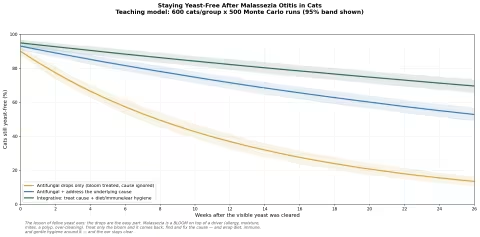
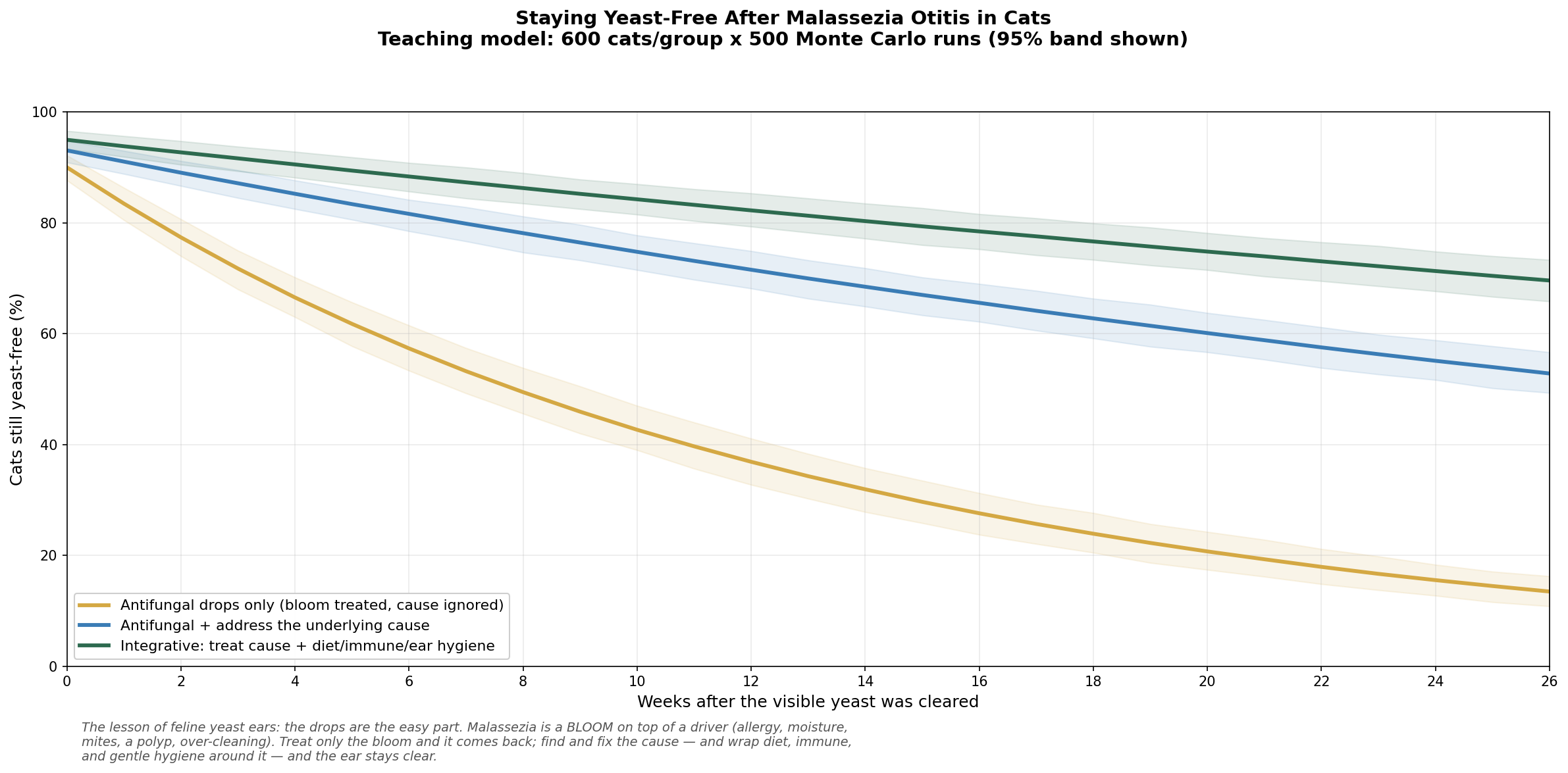
The figure above is a teaching model — 600 simulated cats per strategy, 500 Monte Carlo runs — tracking the fraction of cats that stay yeast-free over six months after the visible yeast is cleared. The ordering is the whole point:
- Antifungal drops only (gold): the bloom clears fast and the ear looks great in a week — then a large fraction relapse, because the underlying driver (allergy, moisture, mites, a polyp, over-cleaning) was never addressed. This is the single most common reason a cat is "always getting yeast ears."
- Antifungal + fix the underlying cause (blue): far more durable. Find the driver, remove it, and the yeast has nothing to bloom on.
- Integrative — treat the cause plus diet, immune support, and gentle hygiene (green): the most durable of all, because it both removes the driver and builds the kind of resilient, well-fed cat whose canals resist colonization in the first place.
The cat-safe yeast-ear protocol (outer ear, intact eardrum confirmed by a vet):
- Confirm it's yeast first. Cytology, not a guess. Brown wax is not automatically yeast, and the wrong treatment wastes weeks.
- Clean gently and dry thoroughly. A veterinary ear cleaner (or a mild, vet-approved witch-hazel/calendula rinse) to lift debris — then let the canal dry. Yeast loves moisture; a damp canal undoes the treatment. Clean enough, not constantly.
- Apply an antifungal the vet selects — feline otic products typically pair an azole antifungal (miconazole, clotrimazole) with an anti-inflammatory; for stubborn cases, vet-compounded options exist. This is the engine of clearance.
- Find and fix the driver — treat mites, work up an allergy, remove a polyp, correct an over-cleaning habit. This is the step that stops the relapse.
- Wrap the natural-rearing support around it — the species-appropriate diet, omega-3s, immune support, and the gentle mullein/calendula hygiene of Part IX, all of which lower the recurrence tail.
- Never use garlic (Part VIII) and never put anything in the canal if the eardrum's integrity is unknown — many ear products, including some "natural" ones, are ototoxic through a ruptured drum.
Part V: How Fast Does It Resolve — And With What?
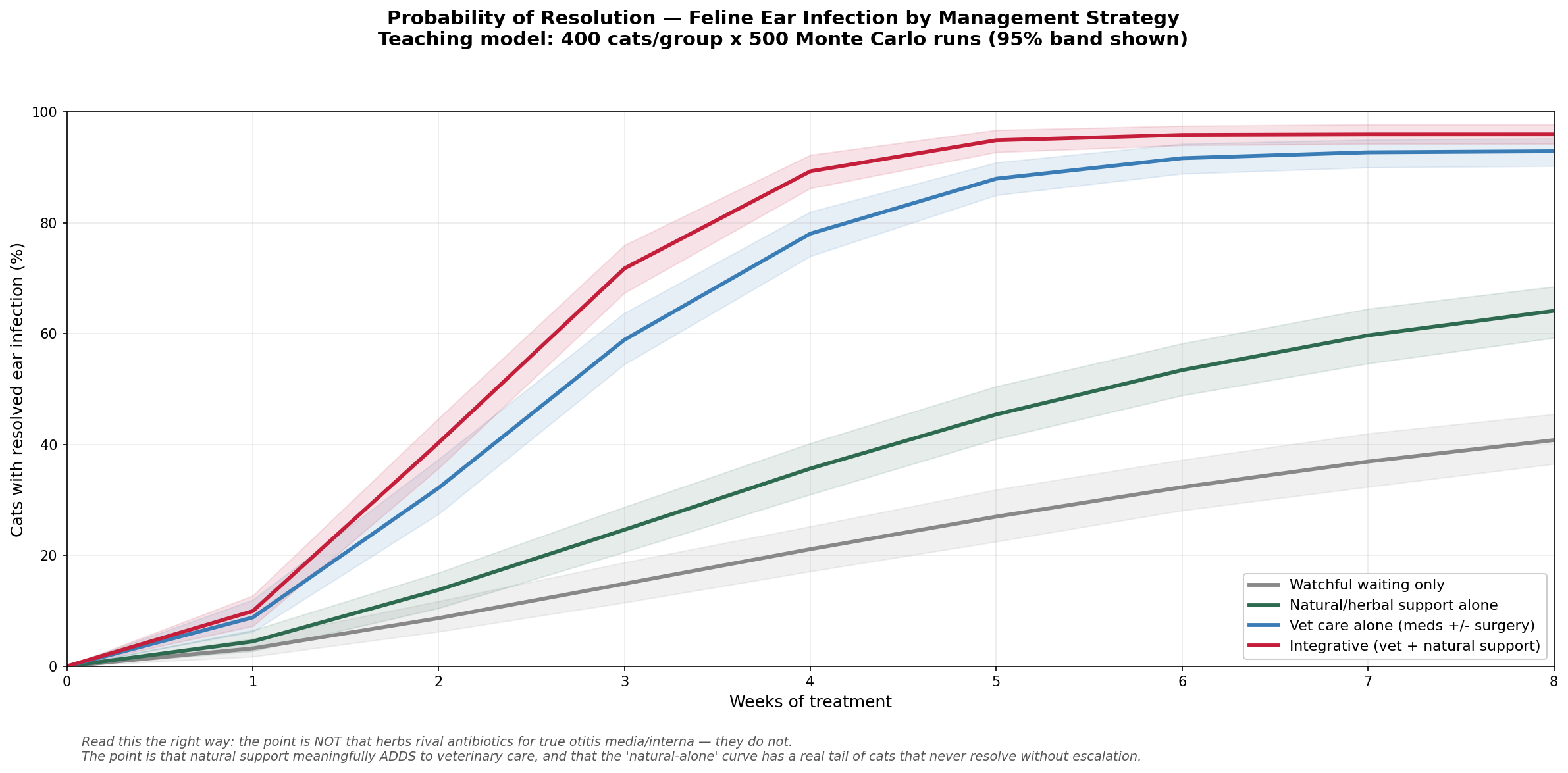
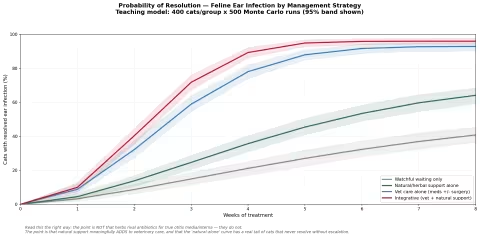
This is the figure that anchors the whole article's honesty. It is a teaching model — 400 simulated cats per strategy, 500 Monte Carlo runs each — built so that the ordering of outcomes reflects what veterinary medicine actually observes, even though the exact numbers are illustrative rather than from a single trial.
Four strategies, tracked over eight weeks:
- Watchful waiting only (grey): plateaus low. A meaningful fraction of true middle/inner-ear infections simply do not self-resolve, because the underlying cause (a polyp, deep bacteria) is still there.
- Natural/herbal support alone (green): does better than nothing — diet, immune support, gentle ear hygiene genuinely help mild and early cases — but it carries a long tail of cats that never resolve without escalation. That tail is the whole point.
- Veterinary care alone (blue): meds, ear flushes under anesthesia, polyp removal, surgery when needed. Fast and reaches a high resolution ceiling.
- Integrative — vet care plus natural support (red): the best curve. Slightly faster and slightly higher than vet care alone, because the natural-rearing measures reduce recurrence and support recovery.
Read the figure the right way. The message is not "herbs rival antibiotics for a deep ear infection." They do not, and any source that tells you otherwise is selling something. The message is:
- For a true otitis media/interna, veterinary care is the engine of resolution.
- Natural rearing is a powerful adjunct and an even more powerful preventive — the integrative curve beats everything.
- Going natural-alone on a deep infection means accepting that real tail of cats who lose hearing, keep a permanent head tilt, or develop a brain infection. That is a gamble no one who loves their cat should take.
This is, in fact, exactly what de Bairacli Levy practiced. She was not an ideologue who refused all intervention; she was a pragmatist who reached for the gentlest effective tool and escalated when an animal needed it.
Part VI: The Vestibular Storm — Loss of Balance, and Why It Looks Worse Than It Is
When inner-ear infection sets off the vestibular system, the acute picture is genuinely alarming: a cat who cannot stand, who rolls, whose eyes won't stop moving. Owners frequently fear the worst. Here is the reassuring biology.
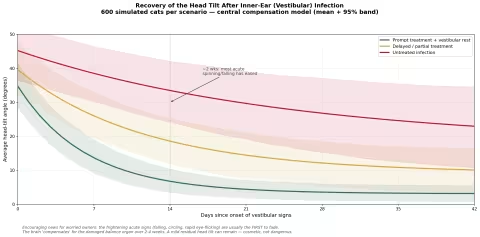
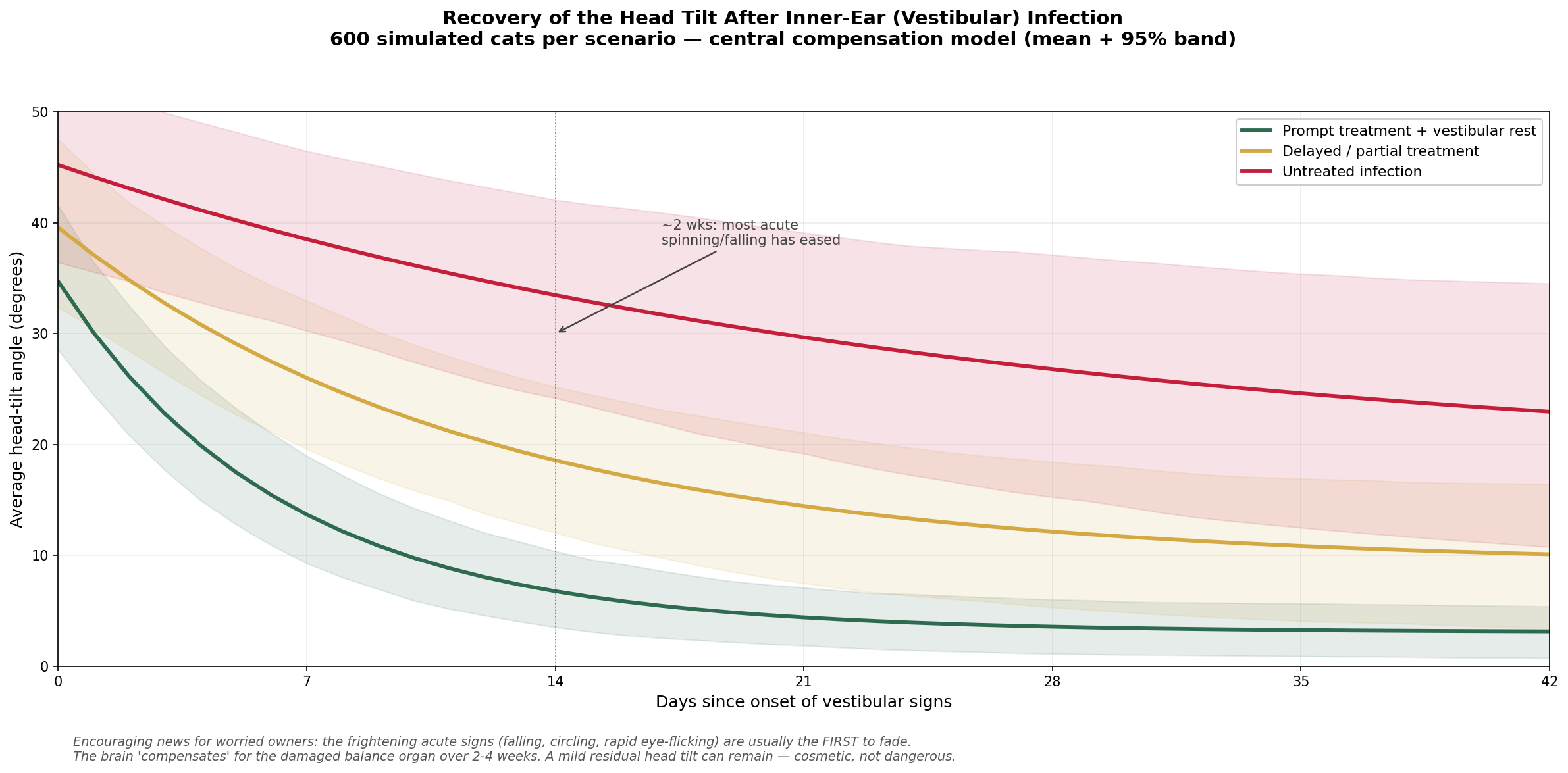
The brain is remarkably good at compensating for a damaged balance organ. Once the underlying infection is brought under control, the central nervous system recalibrates — leaning on vision and the other (healthy) inner ear to reconstruct a sense of "up." The figure models the head-tilt angle over six weeks across three scenarios. In every case, the frightening acute signs fade first: the rolling and the rapid eye-flicking usually settle within the first one to two weeks. What can linger is a mild residual head tilt — and in a treated cat that residual is small, cosmetic, and entirely compatible with a happy life.
The contrast in the figure is the lesson:
- Prompt treatment + vestibular rest (green): fastest decay, smallest residual tilt.
- Delayed/partial treatment (gold): slower, larger residual.
- Untreated (red): the tilt barely improves, because the infection driving it is still active — and this is the scenario that risks deafness and inward spread.
Supportive nursing during the vestibular storm — this is where natural rearing genuinely shines, because most of it is about comfort and letting the body do its work:
- Confine for safety: a padded, enclosed space with no stairs, no high perches, no furniture to fall from.
- Hand-feed and hand-water if the cat is too dizzy or nauseated to reach the bowl; a syringe of warm bone broth keeps fluids and calories up.
- Quiet, dim, still: motion and bright light worsen the nausea, exactly as in human seasickness.
- Gentle reassurance and stroking: stress hormones impair recovery; a calm cat compensates faster.
- Ginger (a tiny amount of fresh-grated root in food, or a drop of weak ginger tea) is a traditional anti-nausea aid that is safe for cats in small amounts.
Part VII: The Herbal Evidence, Honestly Weighed
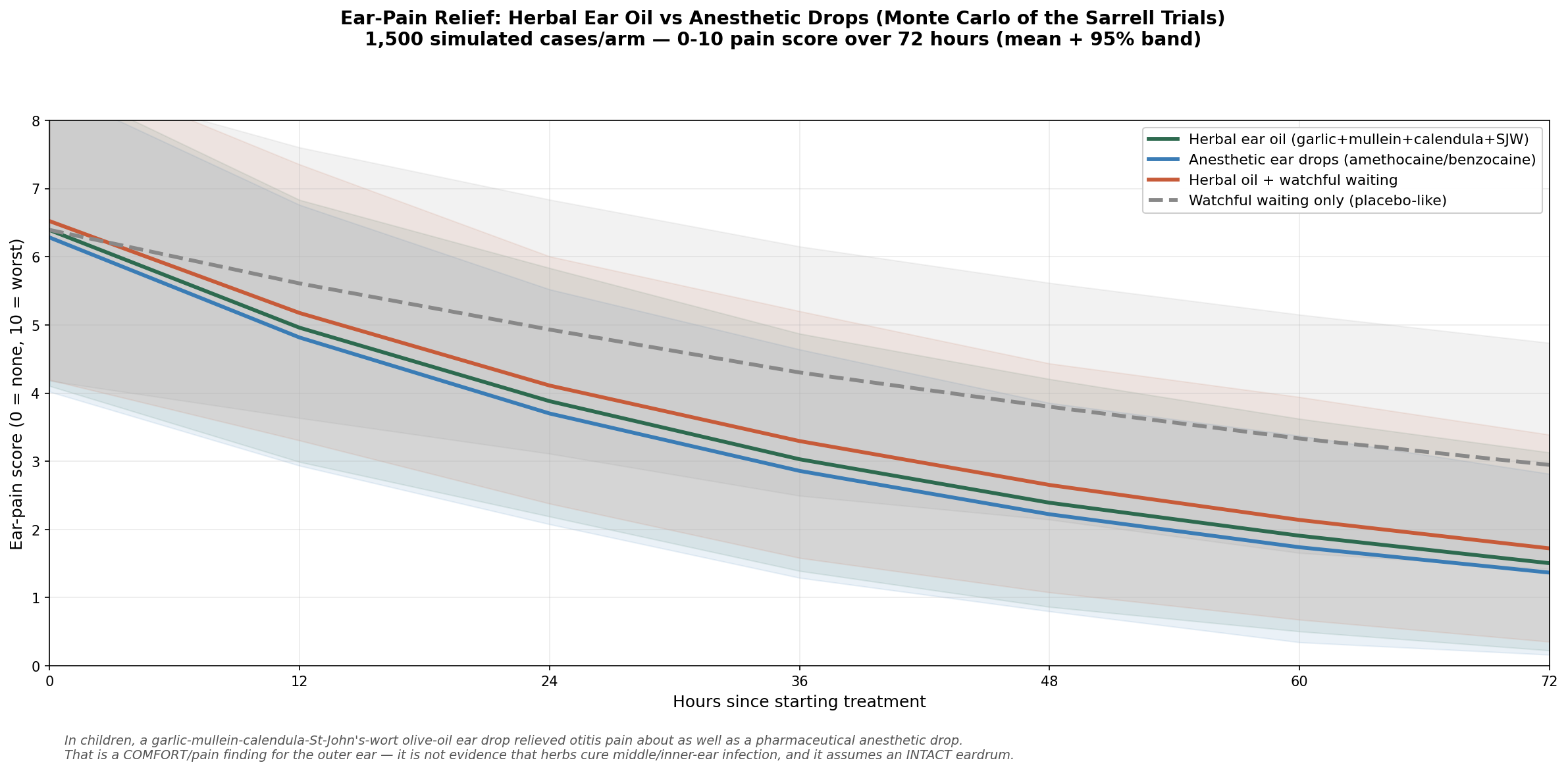
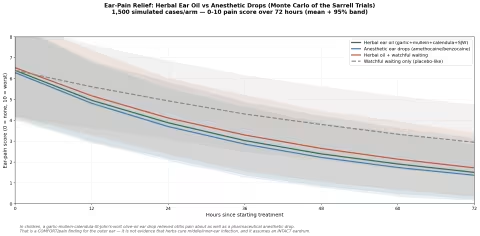
Let's return to those Sarrell trials, because they are the strongest evidence the herbal tradition has, and it is important to understand precisely what they show. The figure is a Monte Carlo recreation — 1,500 simulated cases per arm — of the pain trajectories those studies measured.
The garlic-mullein-calendula-St. John's-wort oil tracks the pharmaceutical anesthetic drop almost exactly, and both clearly beat watchful waiting on pain. That is a real, replicated, double-blind finding. But notice three boundaries on it:
- It measured pain, not cure. The herbal oil soothed the ache of otitis. It did not eradicate the infection — in both the herbal and conventional arms, the infection itself was expected to resolve largely on its own (most childhood ear infections do), with the drops providing comfort in the meantime.
- It was the outer ear, with an intact eardrum. Every child in those trials had a normal, unperforated drum. The oil never touched the middle or inner ear.
- It was a human study. Cats are not small children. The most important difference is coming up in the next section.
So here is the defensible position. For a cat with mild outer-ear irritation and a confirmed-intact eardrum, a gentle warmed herbal oil — the kind de Bairacli Levy would have reached for — is a reasonable, evidence-adjacent comfort measure. For a cat with any sign of middle- or inner-ear disease, herbal oils are not just unsupported; they are potentially dangerous, because anything that reaches the inner ear through a ruptured drum can poison the very organ of balance you are trying to save.
Part VIII: The Garlic Problem — Where de Bairacli Levy's Advice Must Be Adapted for Cats
This section is the most important safety lesson in the entire guide, and it is one that devotees of natural animal care sometimes get badly wrong.
Garlic is the backbone of de Bairacli Levy's herbal pharmacy. She fed it, by her own account, to virtually every animal she reared, as a natural antiseptic, vermifuge (worm-expeller), and tonic. And for dogs and livestock, in sensible amounts, that tradition has reasonable footing.
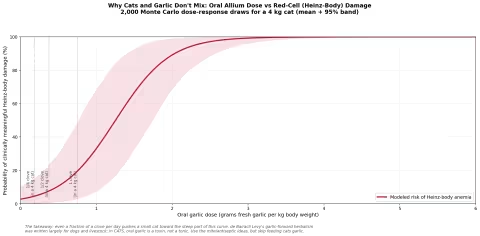
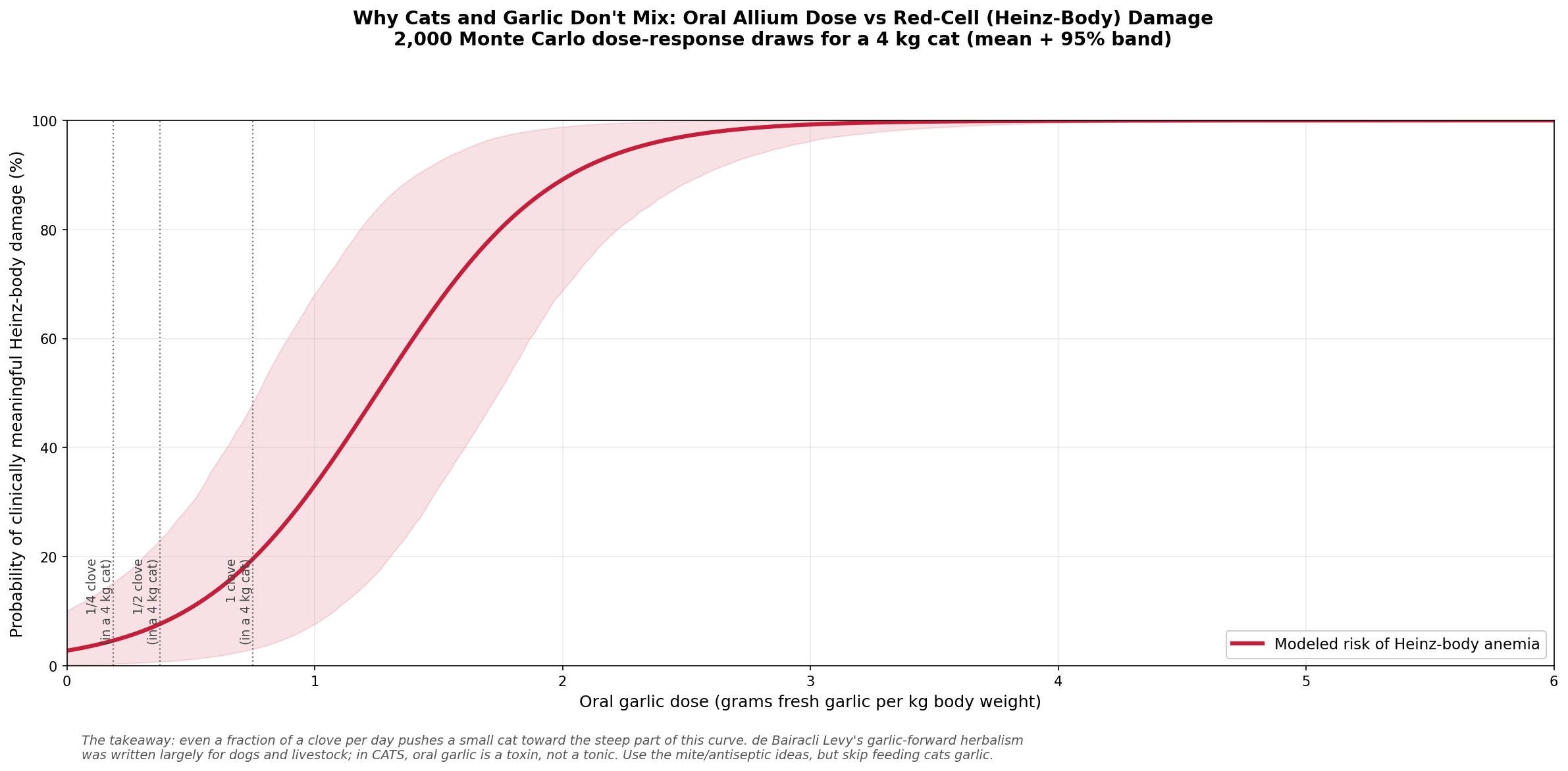
Cats are the dramatic exception. Cats are extraordinarily sensitive to the allium family — garlic, onion, leek, chives. Feline hemoglobin has an unusually high number of oxidation-prone sulfhydryl groups, which means the oxidant compounds in garlic damage feline red blood cells far more readily than those of any other common pet. The damage shows up as Heinz bodies — clumps of denatured hemoglobin — and, with enough exposure, hemolytic anemia: the destruction of the cat's own red blood cells.
The figure models this dose-response for a typical 4 kg cat. Note where the reference lines fall: even a fraction of a clove of fresh garlic puts a small cat onto the steep, dangerous part of the curve. Garlic is roughly five times more toxic to cats than to dogs by weight, and cats are smaller to begin with. There is no "tonic dose" of oral garlic for a cat that is reliably below the harm threshold.
The adaptation rule for cats:
- Do not feed cats garlic, onion, or any allium — not raw, not cooked, not powdered, not in "natural" supplements that contain it. This includes many garlic-based flea and "immune" products marketed for pets; read every label.
- de Bairacli Levy's garlic-forward protocols were written largely for dogs and farm animals. Take her principles — clean food, herbal antisepsis, supporting the whole animal — and her non-garlic remedies, and leave the oral garlic for the dog.
- Topical garlic-in-oil ear preparations (as in the human ear-drop trials) are a separate question with far less systemic absorption, but even these should never go into a cat's ear if the eardrum might be ruptured, and are best avoided in favor of mullein-and-calendula oils given how sensitive cats are.
This is not a refutation of natural rearing. It is natural rearing done correctly — with the species-specific knowledge that de Bairacli Levy herself prized above dogma.
Part IX: The Natural-Rearing Protocol — Adapted Faithfully for Cats
Here is how to translate Juliette de Bairacli Levy's philosophy into a concrete, cat-safe program. Everything below is supportive and preventive, designed to wrap around veterinary diagnosis and treatment of any genuine infection — never to replace it.
Pillar 1: The Foundation Diet
De Bairacli Levy's first principle was always food. A cat is an obligate carnivore, and her natural-rearing diet for cats centers on fresh, species-appropriate animal protein rather than highly processed, grain-heavy kibble. A well-formulated raw or gently-cooked diet, or at minimum a high-quality moisture-rich diet, supports the skin and mucous membranes (including the ear-canal lining) and the immune competence that keeps chronic and recurrent otitis at bay.
Family note: per your household preferences, this means no fish-based cat foods (easy — poultry and rabbit are more species-typical for cats anyway) and a strong preference for organic sourcing. Avoid the soy fillers found in cheap cat foods regardless.
A genuinely complete feline raw or home-prepared diet must be properly balanced (correct calcium:phosphorus, added taurine, etc.) — work from a veterinary-nutritionist-formulated recipe rather than improvising, as cats have absolute requirements (taurine, arachidonic acid, preformed vitamin A) that a careless raw diet can miss.
Pillar 2: The Therapeutic Fast (Used Judiciously)
A cornerstone of her method was the short fast at the first sign of illness — the observation that sick animals instinctively stop eating to divert energy toward healing. For many conditions this is sound.
For cats, this requires a critical caveat: cats must never undergo a prolonged fast. Unlike dogs, a cat deprived of food for more than 24–48 hours — especially an overweight one — can develop hepatic lipidosis (fatty liver), a life-threatening condition. So: a brief easing of food for a few hours while you get a sick cat to the vet is reasonable; a multi-day fast is dangerous. Honor the principle, respect the feline metabolism.
Pillar 3: Gentle Herbal Ear Hygiene (Outer Ear, Intact Drum Only)
For routine cleaning of a healthy or mildly waxy outer ear — and only once a vet has confirmed the eardrum is intact:
- Calendula (Calendula officinalis) infusion or a few drops of calendula-infused oil: soothing, anti-inflammatory, gentle. A de Bairacli Levy favorite and well-tolerated by cats.
- Mullein (Verbascum) flower oil: the classic ear herb, mildly antimicrobial and pain-soothing — the backbone of the Sarrell formula, minus the garlic.
- Witch hazel or a dilute green-tea infusion on a cotton pad to wipe (never deep-swab) the visible part of the canal.
- Almond or olive oil, slightly warmed, to soften and float out wax and debris — the simplest and oldest remedy of all.
Apply only to the part of the ear you can see, never force anything deep, and stop immediately if the cat shows pain or any neurological sign.
Pillar 4: Ear Mites — The Oil Smother
Because mites are such a major feline cause, the traditional oil-smothering approach is worth knowing: a warmed, bland oil (almond, olive) applied daily to the canal physically suffocates mites and loosens debris. Many integrative practitioners add a drop of neem or a little calendula. This is genuinely useful for a confirmed, uncomplicated mite infestation of the outer ear — but a heavy infestation, or any sign it has gone deeper, needs a veterinary miticide, because mites that rupture the drum are how mite infestations become the inner-ear infections this article is about.
Pillar 5: Whole-Animal Immune Support
De Bairacli Levy treated the animal, not the symptom. Cat-safe supportive measures:
- Honey (raw, a tiny amount): she used it widely as a gentle antiseptic and energy source; a quarter-teaspoon is safe for most cats and can be offered during recovery.
- Colostrum or a feline-appropriate probiotic to support gut-based immunity.
- Omega-3 fatty acids — and yes, fish-oil supplements are fine even in a no-fish-food household; they are anti-inflammatory and support skin and mucous-membrane health.
- Sunlight and fresh air, another of her constant themes — a safe, sunny window perch is genuine medicine.
Pillar 6: Homeopathic Adjuncts
Within the holistic tradition (and per your family's use of these), several remedies are classically indicated for ear complaints and the vestibular picture, used alongside veterinary care:
- Pulsatilla — for bland, changeable ear discharge in a clingy, gentle cat.
- Belladonna — for the hot, red, acutely painful ear of sudden onset.
- Hepar sulphuris — for painful, infected ears where the cat resents any touch.
- Conium maculatum — classically associated with vertigo worsened by movement, sometimes used for the head-tilt/vestibular picture.
Part X: The Best-Practice Treatment Protocol
Here is the whole article distilled into a single, ordered protocol — the integrative best practice that pairs conventional veterinary diagnosis and treatment (the engine of cure) with the natural-rearing wrap (the support and prevention). It is staged deliberately, because the right treatment depends entirely on which compartment is involved and what's driving it. Do not skip a stage.
Stage 0 — Triage (you, at home, in two questions)
The two-question triage from Part III decides everything: (1) Outer ear or deeper? (2) Could the eardrum be ruptured? Any vestibular sign — head tilt, loss of balance, stumbling, circling, flicking eyes — or any facial-nerve sign jumps you straight to Stage 1 today. A clean neurological exam with just head-shaking and a smelly ear means you can proceed more calmly, but a vet still needs to look before anything goes in the canal.
Stage 1 — Diagnosis (the veterinarian, and there is no substitute)
This is the step natural care cannot perform, and it determines the entire treatment:
- Otoscopy of both ears — including assessing whether each eardrum is intact (often under sedation if the ear is too painful).
- Cytology — a swab on a slide tells yeast from bacteria from mites in minutes. This single test prevents most treatment failures.
- Culture and sensitivity — for deep or resistant bacterial infection, to choose the right systemic drug.
- Look for a polyp or mass, and image the bullae (radiographs/CT) if middle/inner-ear disease is suspected.
Stage 2 — Treat by compartment
| Compartment / cause | Conventional engine (the vet) | Natural-rearing wrap (alongside) |
|---|---|---|
| Yeast (Malassezia) otitis externa | Clean + dry; azole antifungal otic; fix the driver (Part IV) | Mullein/calendula hygiene, keep canal dry, diet & omega-3 to cut recurrence |
| Bacterial otitis externa | Cytology/culture-guided antibiotic otic; clean | Soothing calendula, immune support; never delay the drops |
| Ear mites | Vet miticide (esp. if heavy or deep) | Oil-smother for mild, confirmed outer-ear cases (Part IX) |
| Otitis media | Systemic antibiotics ± deep flush under anesthesia | Nursing, diet, immune support; nothing in the canal if drum unknown |
| Otitis interna / vestibular | Prolonged systemic therapy; treat the source | Vestibular nursing (Part VI), anti-nausea ginger, calm/dim/confined |
| Inflammatory polyp | Physical removal (traction-avulsion or surgery) | Post-op support only — no herb shrinks a polyp |
Stage 3 — The natural-rearing wrap (runs in parallel, never instead)
Layer the supportive program from Part IX around whatever Stage 2 requires: the species-appropriate, organic, fish-free, no-soy diet; omega-3s (fish-oil supplements are fine); a feline probiotic; nursing comfort; and the family's homeopathic adjuncts where indicated. This is what bends the recurrence and recovery curves in the figures.
Stage 4 — Prevent the next one
Once cleared: keep the canal dry and lightly maintained, not over-cleaned; keep the immune-supporting diet going; recheck cytology if the cat is a repeat offender (a recurring yeast ear means an unaddressed driver — go back to Part IV); and address allergy or polyps definitively so the ear stops relapsing.
A worked example — putting it together for a cat with a new head tilt and stumbling (suspected otitis interna):
Hour 0 — this is a same-day veterinary visit, not a home-care situation. The vet will examine both eardrums (often under sedation), look for a polyp, possibly image the bullae (CT/radiographs), take a cytology sample and culture, and start appropriate systemic therapy. Nothing goes in the ear canal at home until this happens.
Alongside veterinary treatment (the natural-rearing wrap):
- Nursing: confined padded space, hand-feeding warm broth, dim and quiet, gentle reassurance.
- Anti-nausea comfort: a trace of fresh ginger in food.
- Diet: maintain excellent moisture-rich, species-appropriate nutrition (no fasting — risk of hepatic lipidosis); organic, no fish-based food.
- Immune support: omega-3 (fish oil is fine), a feline probiotic, a lick of raw honey during recovery.
- Homeopathic: Conium or Belladonna per the presenting picture, if your family uses these.
Weeks 1–4: expect the dramatic signs (rolling, eye-flicking) to fade first; a mild residual tilt may persist and is usually cosmetic. Keep the immune-supporting diet going to prevent recurrence.
If a polyp is found: it must be removed (traction-avulsion or surgery). No herb or diet shrinks a polyp; this is the mechanical-cause lesson from Part III.
For mild outer-ear maintenance afterward (intact drum confirmed): warmed almond/calendula/mullein oil for cleaning, never garlic, never deep-swabbing.
Part XI: Recommended Products
These are gentle, cat-appropriate options that fit the natural-rearing approach for outer-ear maintenance, nursing, and whole-animal support — not substitutes for veterinary treatment of a confirmed middle/inner-ear infection. All are garlic-free and chosen with your preferred brands and no-fish-food / organic preferences in mind. For pet-specific formulas, two trusted specialty makers are worth knowing: Vitality Science (cat- and dog-specific herbal and probiotic wellness products) and Only Natural Pet (a broad natural-pet line including ear care, supplements, and homeopathics).
Gentle Ear Care (Outer Ear, Confirmed-Intact Drum)
- Mountain Rose Herbs Mullein Flowers — organic dried flowers to infuse your own warmed ear oil (the classic, garlic-free version of the Sarrell formula).
- Mountain Rose Herbs Calendula Flowers — organic, for a soothing infused oil or rinse.
- Gaia Herbs Calendula — professional-grade calendula extract from a preferred brand.
- Only Natural Pet Ear Cleaner / Herbal Ear Care — ready-made cat-safe ear cleansers and witch-hazel/herbal wipes for routine outer-ear hygiene (check labels and choose garlic-free formulas).
- Vitality Science Super Gut Tonic & topical herbal line — cat-specific herbal preparations for skin and ear support.
- Plain organic sweet almond oil or extra-virgin olive oil — for warming and gentle wax-softening; any organic culinary grade works.
- Witch-hazel-based drying ear rinse (e.g., Only Natural Pet herbal ear cleanser) — for the yeast-prone ear, a mild astringent helps lift waxy debris and leave the canal dry (yeast loves moisture). Use sparingly — over-cleaning feeds the bloom — and only on a confirmed-intact drum. The antifungal otic itself, when needed, is a veterinary prescription.
Whole-Animal & Immune Support
- Dr. Mercola Antioxidant Support / Omega-3 for Cats — clean omega-3 support from a preferred brand (fish-oil supplements are fine in your household).
- Vitality Science Feline Comfort & Probiotic / Immune products — cat-formulated probiotic and immune-support blends that fit the whole-animal philosophy.
- Only Natural Pet Daily Probiotic / Immune Support for Cats — feline-dosed probiotics and immune blends from a specialty natural-pet line.
- Pure Synergy — whole-food antioxidant support for the human caregivers building the program; many of their principles inform the diet philosophy.
- MaryRuth Organics liquid probiotic — gentle, easy-to-dose liquid format (use a feline-appropriate probiotic dose).
- Raw organic honey (local if possible) — for a recovery lick and gentle antiseptic use.
- A veterinary-nutritionist-balanced organic raw or gently-cooked feline diet — poultry/rabbit based, no fish, no soy filler, with proper taurine and calcium balance.
Homeopathic (Per Family Preference)
- Newton's Homeopathics — feline/ear & vertigo combinations — your family's preferred homeopathic brand; combination remedies covering the inflammatory and vestibular pictures.
- Only Natural Pet Homeopathic remedies for cats — convenient pet-dosed single and combination remedies.
- Boiron Belladonna 30C — for the hot, acutely painful ear.
- Boiron Pulsatilla 30C — for the bland, changeable-discharge picture.
- Boiron Conium maculatum 30C — classically associated with motion-worsened vertigo.
Part XII: When It Is an Emergency — Red Flags
See a veterinarian the same day — do not attempt home/herbal management — if your cat shows any of these:
- Head tilt, circling, falling, rolling, or loss of balance (inner-ear / vestibular signs)
- Rapid, involuntary flicking of the eyes (nystagmus)
- Facial droop, inability to blink, or a constricted pupil / droopy lid on one side (Horner's syndrome — middle-ear nerve involvement)
- Pain when opening the mouth or chewing
- Bleeding or pus from the ear canal, or a sudden foul odor
- Sudden deafness on one side
- Lethargy, fever, loss of appetite, or vomiting alongside ear signs (possible inward spread)
- Any ear sign in a cat where the eardrum's integrity is unknown — because home ear preparations can be ototoxic through a ruptured drum
- A visible mass or growth in or at the ear canal (possible polyp or tumor — needs removal, not medication)
- Symptoms that worsen, or fail to clearly improve, despite care
Inner-ear infection sits a few millimeters from the brain. The natural-rearing measures in this article are the supportive wrap around prompt veterinary diagnosis and treatment — never a reason to delay it.
Part XIII: The Honest Bottom Line
A cat's middle and inner ear are among the few places where the gentle, food-and-herbs philosophy of natural rearing must defer, on the central question of cure, to the veterinarian's otoscope, culture swab, and (when there is a polyp) surgical instruments. The deep ear is simply not reachable by the tools an herbalist has, and the stakes — hearing, balance, and the nearby brain — are too high to gamble.
But this is not a defeat for Juliette de Bairacli Levy's vision. It is a vindication of the honest version of it. She built her medicine on observation, on respecting each species' particular nature, and on supporting the whole animal so that serious illness rarely takes hold in the first place. The cat raised on excellent food, with clean ears and a robust immune system, is the cat least likely to ever present with a tilted head on a frightening morning. And the cat who does present that way recovers faster, more completely, and with less recurrence when the natural-rearing wrap — nursing, diet, immune support, calm — is laid around the veterinary care that does the heavy lifting.
The three biggest mistakes owners make with feline ear infections:
- Treating a deep infection as a surface one — dripping oils and home remedies into an ear with vestibular signs, while the real problem (a polyp, deep bacteria) marches on. The tilted head is a vet today sign.
- Importing dog advice — especially garlic — into a cat. Cats are not small dogs. Oral garlic is a toxin to them, full stop.
- Doing the easy half of natural rearing (a supplement) and skipping the hard, powerful half — the species-appropriate diet and the whole-animal immune building that actually prevents recurrence.
Get the triage right, keep the garlic away from the cat, feed her as the carnivore she is, and let the herbs do what they do beautifully — soothe, support, and prevent — while the veterinarian reaches the places herbs cannot. That is natural rearing as Juliette de Bairacli Levy actually practiced it: gentle by default, decisive when an animal's life requires it.
References
Feline ear anatomy, causes, and clinical signs:
- Cornell University College of Veterinary Medicine, Cornell Feline Health Center — "Feline Ear Disorders." vet.cornell.edu
- Merck Veterinary Manual — "Otitis Media and Interna in Cats (Middle and Inner Ear Infections)." merckvetmanual.com
- VCA Animal Hospitals — "Inner Ear Infection (Otitis Interna) in Cats." vcahospitals.com
Yeast (Malassezia) otitis — biology, diagnosis, and the secondary-overgrowth model:
- Merck Veterinary Manual — "Otitis Externa in Cats" (yeast/Malassezia pachydermatis as a secondary overgrowth; cytology-based diagnosis). merckvetmanual.com
- VCA Animal Hospitals — "Ear Infections (Otitis Externa) in Cats" (importance of identifying and treating the underlying/primary cause to prevent recurrence). vcahospitals.com
- Bond R, et al. "Malassezia pachydermatis and its role in canine and feline dermatologic and otic disease." Review of the commensal-to-pathogen overgrowth model. Vet Dermatol.
Herbal ear-drop clinical evidence (human pediatric):
- Sarrell EM, Mandelberg A, Cohen HA. "Efficacy of naturopathic extracts in the management of ear pain associated with acute otitis media." Arch Pediatr Adolesc Med 2001. PMID 11434846
- Sarrell EM, Cohen HA, Kahan E. "Naturopathic treatment for ear pain in children." Pediatrics 2003. PMID 12728112
Garlic / allium toxicity in cats:
- ASPCA Animal Poison Control and Pet Poison Helpline — allium (garlic/onion) toxicosis and Heinz-body hemolytic anemia in cats. (Cats are markedly more sensitive than dogs; avoid all dietary allium.)
Natural-rearing philosophy and herbal traditions:
- de Bairacli Levy, Juliette. The Complete Herbal Handbook for the Dog and Cat. Faber & Faber, 1955 (and later editions).
- de Bairacli Levy, Juliette. Cats Naturally: Natural Rearing for Healthier Cats. Faber & Faber, 1991.
This article is an educational guide for cat owners interested in holistic and natural-rearing approaches. It is not a substitute for veterinary diagnosis or treatment. Middle and inner ear infections in cats are serious conditions that require prompt veterinary care; the natural measures described here are intended to support — never to replace — that care. Never place any substance into a cat's ear canal if the eardrum's integrity has not been confirmed by a veterinarian, and never feed cats garlic, onion, or other allium-family foods or supplements.